LandRoverWriter.com

LandRoverWriter.com
The Land Rover Writer

Wednesday, January 18, 2012

Tata Staring at Saab?

I've picked up hints that Tata, the Indian conglomerate that owns Jaguar Land Rover, has studied the possibility of purchasing Saab, the bankrupt Swedish manufacturer of interesting cars.


Tata benefited from the development work already underway at both firms through Ford's parentage; GM did not appear to be as generous with Saab and the company would need some real capital to develop new products. That said, Tata has been a good corporate parent to date and it certainly has the energy and focus to become a major player in the automotive world. 

Surely there's a place in this automotive universe for Saab. The company went front-wheel drive for traction in snowy conditions and interior packaging long before the Mini elevated it to cult status in 1959. 


Starting in 1957 they developed a strong niche market for themselves in New England as the "bad weather car of choice," first with their quirky 2-cycle engines, and then cemented by their Monte Carlo Rally wins with small V-4 engines against far more powerful cars and better-financed teams. 

In central Maine a former Saab dealer has an extensive collection of classic Saab models housed in his barn; a salesmen at a southern Maine Chevy dealership still owns and drives a 2-cycle model to Saab events all over New England. 

The 1980's saw Saab move upscale and revive the use of the turbocharger in small 4-cylinder engines; they took the 2.0 liter Triumph 4 and made it into a reliable, long-lived performer. After GM bought Saab it seemed to devolve into a mini-Buick and lose some of the sharp engineering that always made it an engaging car to own and drive.  

GM still seems eager to kill the brand as it still seems to have a veto on financing schemes to revive manufacturing of the car. Let's hope that this marque does not disappear into history.

Tuesday, January 17, 2012

Kudos to a Car Club

This article appeared in this morning's email newsletter from Hemmings Motor News.

It offers a heady reminder that classic cars can serve multiple roles in our lives. They can be sources of excessive ego-stroking or they can be sources of communal satisfaction. The cars are object that we imbue with purpose and symbolism; it's what we do with the car that makes us enthusiasts sharing our talents, interests and energies - and of course, hard-earned dollars. 

I admit to envy for those who can afford to have their classic cars restored and detailed so to look brand new, but if all those owners do is display the car, they've missed the main reasons to own classic cars.  Auto manufacturers engineered, designed and sold cars to be driven; if all you do is show the car at events, if you're afraid to drive it because of its "investment value," you're missing the point.


This Georgia Corvette Club refurbished a car for a family that had given so much, and in turn, they created a daily driver that gave them so much in return. Job well done!

Monday, January 16, 2012

Old Cars and Winter

It's taken longer than usual for winter to hit here in Maine, but finally we have temperatures around 0 degrees F and some snow on the ground. It's rare that we can be this comfortable so late into winter.


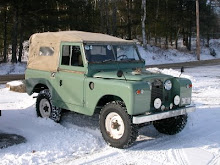
The cold and high winds came on strong this weekend. I could hear their effects when I went to start the 46 year old Land Rover. I've never done a compression test on this engine, but after some 400,000 miles and some 17 years of daily use, it's probably not at 150 psi on every cylinder. Combine that with an oil capacity of 7+ quarts and a single, manual choke carburetor, and you have the makings of hard winter starting. This new starter helps churn the engine so it will fire quickly - it does sound funny, though, as if something's not tight. I'll have to check it when it warms up.


Normally I could minister to the car gently upon starting it at 0 F. You pump the accelerator a few times, pull out the choke, press the starter button, and once it fires up, wait a few moments before driving off. You try to warm the car up while driving so you can push in the choke as soom as possible. This helps reduce carb icing and the "wash down" effect that gas has on the oil that lubricates around the piston rings. 

Since I became an EMT a couple of years ago I don't have that luxury. I must start the car quickly, force it into gear [the thick gear oil makes shifting hard], run the car a short distance, and then turn off the engine. Few things will accelerate engine wear faster than this ritual - it runs counter to everything I learned about how to take car of older design engines.   


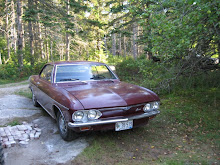
The 46 year old Corvair handles this for me very well; with its twin carburetors and automatic choke, it simply won't run at all if you try and move too quickly upon a very cold start. You must wait for it to warm up some before driving away.  


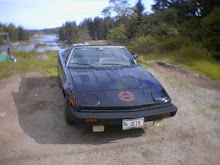
The 32 year old TR-7 used to be a brisk starter and runner in cold weather, but ever since it developed its head gasket leak, it won't start well at all- even with the leak seemingly cured. Right now I fear that I might have condensation in the gas because of the car's stationary situation. I purchased a new fuel filter and installed it this weekend, but an EMT call out prevented me from fiddling with the engine very long. It will start [with ether] but would not run on its own. I need to sort that problem out when the temperatures rise later this week.

Thursday, January 12, 2012

Kudos to the Range Rover Evoque

Not long after Land Rover re-entered the US market in 1987, LRNA President Charles Hughes noted that one great challenge for the marque was that relatively few people knew the Land Rover marque at all, and nowhere near enough knew the Range Rover.

You were not only trying to interest people in a particular model, you were trying to convince them to part with their hard-earned dollars and give them to a automobile company that for many had receded into distant memory. After all the last new Land Rovers left the US market in 1974 and they resembled the first ones from 1948 - hardly contemporary in appearance. 

The Rover name had been further tainted by the marketing efforts behind the Rover 3500, and worse, the Sterling [the name given to a Rover-Honda car because old British Leyland litigation might have been resumed had the Rover name appeared on the car], proof that the Rover nameplate did not bring back fond memories.

Give Land Rover credit, though. Starting with the Range Rover, they brought in the Defender, Discovery, Freelander, LR3 and LR4 models, and now, the Evoque. Land Rover enthusiasts like me might shiver at the sight of one but guess what - Land Rover is an automobile manufacturer in business to make money selling new cars every year in over 168 world markets. 

The Defender lineup might be the emotional successor to the Series Land Rover models, but at most Land Rover can make and sell 35,000 of them, out of the over 200,,000 cars produced annually. So the models less-loved by enthusiasts provide most of the profit margin needed by the company.

The Evoque keeps winning award after award. There's a 7 month wait for one in the UK, something that would be nearly impossible to fathom in the instant-gratification world of the US. Good for Land Rover for producing a small Range Rover with 28 mpg highway, eye catching looks and some pretty good off road cred!


Connected to What?

Attention is back to automobiles again with the opening of the North American Auto Show in Detroit. Among the attention-getters is the trend towards wireless connectivity between your devices and your automobile.
Automakers have come to learn that consumer technology can change more rapidly that the lead time for automobiles. Stand-alone devices such as GPS's, digital cameras and even laptops might be rendered obsolete by cellphones and tablets - so why incorporate them into automobiles as optional accerssories?

“While we are already working on the cars that will hit the road seven years from now, the next disruptive consumer technology might hit the market in seven months,” Dr. Dieter Zetsche of Daimler said. “A 20-year-old car might be a classic that you love to drive, but do you know anybody who is still using a 20-year-old mobile phone?” 

That's a good point that centers of the real question. Should automobiles just become an adjunct to the wireless world or should they retain a connectivity unique to themselves?

When one said their car had a certain "feel," they usually meant the way the suspension and steering let the driver know about road conditions. Cars that isolated you from the road, generally through wallowing suspensions, extra bushings and overly-sensitive power steering, offered little to no "road feel."

Now our sense of connection with the road has more to do with the world off the traveled road - the web. Automakers rushed to make their cars connect, through phone systems like OnStar, to hard drive storage, like MySynch. As one commentator noted, why should automakers seek to create unique devices when apps for smartphone or tablet will accomplish the same things. Who needs a stand-alone GPS if they have their cellphone? Garmin and Tom Tom will likely keep searching for answers to that question.

The larger question is whether we should be letting devices answer all theese questions for us. Imagine a time when you looked at a thermometer, saw that it approached 32 F, and drew the conclusion that you needed to drive with added care because black ice might cover parts of the road. Now luxury auto lines compete with who can provide you with the greatest number of features - ones to alert you of icing conditions [the Rover 3500 offered a primitive version of this in the 1970's], whether an obstacle or child is behind you when you're backing up, even parallel parking. Of course, you could just learn to check the weather, get outside the car and just look, and learn how to maneuver your car into tight places.

Nah! 

Tuesday, September 20, 2011

Welcome back to Jensen?

For decades Jensen produced some of the most iconic British GT automobiles.


The Interceptor had the style and flair that landed it accolades during the '60's and 70's, and it continues to be a highly sought after classic today. The Interceptor FF used a Ferguson-designed four wheel drive system and became the precursor of the Audi Quattro. 


Jensen also produced the bodies for the Austin-Healey and later in the '70's, found itself bought out of receivership by Kjell Qvale, the famous US importer of British automobiles. He revived the marque for several years in producing the Jensen-Healey. 

Like TVR, Marcos and Bristol, Jensen has gone in and out of production over the decades but the power of the marque carries it onward.

This latest effort comes on the heels of other small luxury brands starting up, but it would be nice to see this one succeed. 

Monday, April 11, 2011

Alfa Return to US Market Delayed

In a sad note for genuine auto enthusiasts, Alfa Romeo's planned return to the USA market has been delayed by parent corporation Fiat. Now it looks like the earliest we'll see an Alfa through dealerships in 2013.


According to Autoweek, the delays arise out of Fiat's concerns about the proposed designs and engineering from Alfa's Turin studios, and from the desire to take advantage of economies of scale by melding Alfa and Chrysler's manufacturing capacities. It does appear that some Chrysller products will be badged as Alfa's and/or Lancia's, or the converse might happen, as Alfa's might be badged as Chrysler products.

Whatever the decisions to be reached, the beloved Alfa Spider is out of production with its replacement not scheduled until 2013 also. Let's hope that the decision s reached don't dilute Alfa's automotive DNA!

Sunday, April 10, 2011

"I am a Rock, on an Island"

Land Rovers have always prided themselves as "working vehicles." Indeed the earliest ads for Land Rovers cited their role as the "versatile" car, able to work on the farm and then bring you into town.

This past week I tested the Land Rover's working capabilities against an enormous tree stump and a boulder too heavy for three people to lift out of the ground. My Land Rover ended the week 1-1.


The tree stump presented quite a hurdle. Our crew of three dug around the huge root ball and I took a chain saw to any visible roots. We tied a tow strap and a kinetic rope around the tree stump, and I goosed it up the gravel drive for some 30' before I felt the Rover surge ahead and then get thrust backwards - the kinetic rope acts just like a rubber band. The tree stump never budged. We tried a few more times and then I gave up and called in a backhoe.

The boulder lay under the surface right in line with the trench I had to absolutely, positively dig. Three of us tried to lift it out of the ground but it proved too heavy. We dug around the boulder enough to get a tow strap around the rock, and then attached it to the Rover.


First gear, low range, and then I gave it a slow but steady pace. The rock bounded out of its hole and I dragged it up to a place from which we could roll it off to one side. It took three of us to roll it into the woods. Ashley was particularly proud of conquering the rock.


Needless to say I was very happy to have the Land Rover! 

Saturday, April 2, 2011

Hope for the Future

The Bristol epitomizes all that is right - and wrong - with the British automobile industry. 

Built first as a gentleman's sporting car after World War II, their cars have featured quirky styling, so you either love them or hate them. Rarely were two models available at the same time. 


They featured robust engines, usually produced by another manufacturer.They also benefited from solid engineering, good brake systems, and handsome, leather and wood interiors. Auto publications have raved about them for decades.


Sadly they also came with high prices. They've been hand built in small quantities to expensive standards under the long time leadership of Tony Crook. You can buy one at only one dealership located in London. The latest models are actually complete rebuilds of older vehicles updated to modern standards.

Now they're "in administration," which is British for bankruptcy. The company is looking for an investor to purchase it and revive the marque. The same process has occurred several times for TVR and that Blackpool manufacturer is still in business. 

You have to wish this heritage product well. If you're interested in purchasing the company, here's the link for more information. 

Wednesday, March 30, 2011

Ode to Dave Dudley

"Six days on the road" sang Dave Dudley, back when trucking songs were entertaining. I just spent 700 miles or so traveling in the QE I, my '66 Land Rover Series II-A. I'm still exhausted!

The trip from Vinalhaven started with a 90 minute ferry ride, then a 2 hour drive to Portland, ME. I had invited a group of Land Rover enthusiasts, young and old, male and female, to gather at a brewpub and entertain me. They did a terrific job and I had a ball. I also have new offers of places to stay in the future - very cool.

Then came the next morning's drive to Cos Cob, CT, where I had plans to mooch off of new friends, who own a summer house in the island. I mow their lawns and do some simple chores for them, and in return, they grace me with their friendship, hospitality and friendship. It's a very one-sided deal for me.

Before the long trip, however, I chose to tank up at The Seed and Bean, a coffee house started by Land Rover enthusiast Jassy Smith. Her BFF, Barry Jones, and his dog, Sarge, came along to entertain me even more. The artsy building, Jassy's grandmother's one-time residence, made for a welcome change from the chain coffee houses everywhere else in the country. 

 From there it was a noisy 4.5 hour drive to Cos Cob, CT, a village area within Greenwich. The QE I's overdrive linkage had failed two days before departure, but Rovers Down South, which now owns the rights to the Fairey Overdrive, came through with the promise of a linkage rod to be delivered to CT.

Running a Land Rover at highway speeds without an overdrive is not a mechanical problem for the car, but it is a problem for the driver. The gear noise and overall vibration noise is quite high at 60 mph, even with my handheld radio and ear buds. Running a Land Rover at 60 mph is also a financial problem for the driver because of $4.05/gallon gas prices in CT. The Rover gets 18-19 mpg at highway speeds, so it costs a lot to make the 350 mile trip.


While in CT, I met up with Jon, a new enthusiast with a Range Rover Sport, and since I last talked with him in December, two 1980's Land Rovers about to be imported to his driveway in Fairfield. I drove the Rover around Cos Cob and Greenwich a bit, but it mostly sat while I mooched rides or took the train into NYC to gawk and people and buildings. I also saw many Range Rovers and even a Defender in NYC; I could not even imagine driving in Manhattan.


The drive home took 6.5 hours, benefiting from the new overdrive linkage that I installed in an hour the previous Saturday. I felt very tired when I arrived in Rockland, too late to catch the ferry home and worn out by the relative boredom of an interstate drive. The working overdrive did help reduce the fuel usage, though, and made the driving safer. However, the low beam headlights have ceased to work, and I fear that means the dimmer switch must be replaced.


The good news is that the shift lever, worked very calmly by me, remained intact! The bad news is that the latest replacement unit from Rovers North now comes without the mounting bracket, meaning it's not a field repair any longer.