LandRoverWriter.com

LandRoverWriter.com
The Land Rover Writer

Thursday, July 24, 2014

Hot Running

So the Spitfire has taken its place as the "mainland car,"  which means it must make five 200 mile round trips this summer for work assignments. On the first two trips the temperature gauge rose to uncomfortable levels; midway through the second trip I had to stop after 40 miles to raise the bonnet and release radiator pressure to reduce the temperature. In between trips it sits at the ferry terminal on the mainland, which reduces the opportunity for me to work on a fix. 

Yesterday was hot for coastal Maine [80 + F] when I drove to Spitfire to a shop on the mainland for a radiator flush and parts replacement. 

The mechanic removed the lower hose to drain the coolant [he didn't unscrew the drain on the block] and it looked quite awful, as you can see in the photo. He then used a garden hose with strong water pressure to flush out the cooling system, including opening the heater valve, and ran the hose for quite some time. He also cleaned out the overflow bottle. All parts of the system included a lot of brown silt. 


He removed the thermostat and I decided to have him install a new 180 F one, as well as a new, 13 psi cap. He put in a fresh coolant mix, as per the owner's manual, and started up the car, running it for quite some time to get it warm and to circulate out as much of the air as possible. 


When he was done I left and drove the car about 10 miles at 40 - 60 mph, with a lot of stop and go traffic. The gauge indicated running up to 3/4, which activated the fan, and then reducing it to a point between 1/2 and 3/4. At no time did it get above 3/4, and it always dropped whenever I started moving at speed. This was an improvement from what I noticed on my last long trip - and I never had to open the heater valve to reduce the temperature level. 

An unrelated bonus was that no matter what the temperature, the car again returned 30 mpg in mixed driving. 

The real test will come this weekend when I head to give a presentation in Vermont at a Land Rover rally. I'm taking the Spitfire because of the impossibility of getting the Land Rover on and off the ferry during this busy summer season. That's about a 4 hour drive each way and the mechanic did mention his concerns about a head gasket problem causing the higher running temperatures. The good news is that I'll be in a convoy with two Land Rovers so I can always get towed in a pinch! 

Wednesday, July 16, 2014

Return of the Spitfire


It took a bit for the Spitfire to make it home on the ferry.

A friend had driven me to Canton, ME, where I bought the car from a small repair shop. It started up, the brakes seemed to work and a missing wheel stud didn't bother me too much. I started on the 80 mile trip home, followed by a very patient friend in his pickup truck. 

After a few miles the car seemed to hesitate and stumble a bit on acceleration, so I pulled over on the side of the road and poured some Marvel Mystery Oil into the gas tank. I started up again and enjoyed the hilly, winding Rte. 17 drive back towards Rockland.

The drive reassured me that I might have found a pretty good example of the marque. The engine smoothed out and felt as though it had some punch - well, as much as the detuned, emissions-emasculated package might offer. As we approached Augusta and its downtown traffic, the temperature gauge rose to a 3/4 mark and then I heard the electric fan kick in - now that was another reassuring moment. 

The 40 mile drive to Rockland continued without incident. About 5 miles from the ferry terminal my friend called to say he would head north towards his home and leave me to my own devices. "No problem," I said, "I'm almost at the ferry terminal." 

The ferry line requires a U-turn to get a car in line, and as I made that turn, I went to push in the clutch. Nothing happened - it was as if the clutch pedal had frozen in its top position. Nothing would move it. So I had to admit defeat and roll back into a parking spot. Raising the hood showed me nothing at the master cylinder. Since I was against a curb and on a hill I could not jack up the car and look underneath.


Next came a tow to Copeland's Garage and a ferry ride home without the car. When I called Copeland's the next morning they told me the problem was a broken slave cylinder bracket, and that new ones were NLA. 

I lucked out when I called Tim Hutchisen at Penn Ridge Motors in Norway, ME. He had a Spitfire transmission on a bench with a slave cylinder bracket intact; he would mail it directly to Copeland's. Sure enough, a couple of days later the car was ready for the second try at returning it home.

Once home I began to assess the car by using it for errands around the island. The gas gauge would not go beyond 1/4, but Michael Crawford of British Motorworks in MA suggested more Marvel Mystery Oil - "lots of it" - to loosen up the float arm. Slowly but surely, after a few fill ups and MMO, the gauge will now go to 3/4. Resetting the trip odometer helps me be certain I won't run out of gas.

While checking the electrical connections for the gauge I removed the trunk panel and was reminded that Spitfires housed their fuel filters beside the gas tank. Changing out the very old one for new one helped the car run better under acceleration, too.


Next came a simple adjustment of the idle speed after warmup, reducing it to 800 rpm. I also replaced the alternator belt as it had a visible cut on it. 

Although the car had been "tuned up" with new spark plug wires the plugs themselves looked rather old so I bought a new set. Removing the old ones proved difficult; they were wrenched in hard and without much evidence of recent removal or Never Seize. 

The tires that came with the car showed a lot of tread but also some sidewall cracks. Rather than risk a problem I bought 4 new tires, sadly, more snow tire than road tire. It's tough to find narrow 13" tires anymore. 

The car came with a hardtop and a soft top, although the latter was in bad shape. The top was original [the diamond pattern on the fabric provided the evidence] and while the canvas had only one tiny rip, the windows were stiff, broken in spots and even with Gorilla Tape, incapable of keep rain out of the car. A Land Rover friend once owned a Spitfire and had an extra top sitting around; I traded Land Rover parts for it and had Erick Van Sickle of Leyland British in Kennebunkport, ME, install it for me (The car has sat at the Rockland ferry terminal this past week, and with lots of rain, I should find out tomorrow whether the new top is more waterproof than the old one).


While the car came with a soft top boot, it did not have a tonneau. Erick found a used one for me with a rusted zipper. I had a new one installed at Gemini Canvas in Rockland and it works quite well.   

The Spitfire tackled its second long drive for a work assignment and the installation of the new top. The 240 mile round trip demonstrated the following:

1. The Spitfire of that era needs 4000 rpm to run at 60-65 mph. Although the redline is at 5500, that's still a lot of revs for a small engine on highway drives. No wonder the electric overdrive is so treasured.

2. Spitfire seats offer less padding and less comfort than TR-7 seats.

3. Top down driving in a Spitfire is hugely entertaining.

4. Spitfires of this era came with electric fans that don't operate on until about 180 degrees, or 3/4 on the temperature gauge. That's disconcerting to see and while the gauge never pegged itself, nor did the car overheat, it made me nervous for a while (I've purchased Water Wetter for the next trip).

5. Combined highway and two lane fast roads, with some in town toodling, produced 29 mpg.

There's another trip tomorrow and later this month, a long drive to Vermont and back. Here's hoping I don't have to use the tool bag in the trunk.


Sunday, May 11, 2014

Third Time's A Charm

It's my third Spitfire and I couldn't be happier.


The build plate on the car says it was built in February, 1980, and the warranty card indicates it was purchased in March, 1981, by a Mark Kelly at Tom Connelly Pontiac in Norwood, MA. A family member, Norman Kelly, brought it to his seasonal home in Canton, ME, where it spent a lot of time in his barn before selling it to Russell Tracy in the same town. 

Russell owns a small repair garage and he bought it as a possible fun car for himself and wife Pamela. But he found he rarely drove it and, as a matter of fact, never registered it for the road. Russ put it up for sale a short while later and that's how Tim Hutchisen, the expert behind Penn Ridge Motors in Norway, ME, found the car. He liked what he saw but had no time to work on the car and declined to buy it. 


When I went on the search for a sports car to replace my TR-7 Spider, I knew that finances would limit my options. Spitfires never fetch a high initial price and a rubber-bumper one, from mid - 1979 through 1980 [the last year of production] should cost even less. I had answered a number of Craigslist, online, even newspaper ads, in my search. I called Tim because I knew he was a Triumph specialist and because he might know of customer's cars for sale.

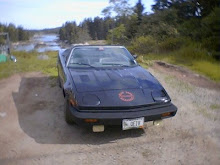
Tim recommended I look at this car because it was "unmolested." Indeed it's very original, including the disco-era "Pageant Blue" paint and black an white check interior seats. Combined with the rubber bumpers, it looked truly appalling compared to other sports cars under consideration: a '78 Spitfire, a '74 MG Midget or a '74 MGB.


Only one of these cars, the Midget, actually had any professional provenance; the others were owned by casual enthusiasts who knew little of the history of their cars. And they were all higher priced than the Spitfire.

I should note that I have a soft spot for Spitfires. Yes, a '63 Spitfire was my first sports car and it cemented my adoration for the marque. I kept it for only two years because I knew so little about their care and feeding. My next one, a '78 purchased in 1989, served as a daily driver and commuter car until the Land Rover joined it in late 1991, but I drove it all over New England until 1998 - and I sold it running at 140,000 miles. I've enjoyed "the sports car life" with an MG Midget, a Fiat Spider, two MGB's and the TR-7 Spider, too, but my heart has remained with Spitfires all those years. 

The Triumph Spitfire provided the company, then Standard Triumph and later British Leyland, the entry level car needed to lure penurious buyers into British sports cars. It featured a simple engine, a massive flip-up bonnet for easy servicing and Italianate styling to entice low budget enthusiasts. The earlier models (1962 - 1971) had a simple swing axle rear suspension that could get exciting at the edge of cornering, but the second generation body style [1971 - 1980] also featured a wider stance and refined double halfshaft suspension to clamp down the rear end. Although the styling managed to hold up well in the rush to make "safer" cars in the 70's the engine's horsepower ratings succumbed to emission controls that relied on lower compression, air pumps and catalytic converters to make them breathe cleaner. Still, it remained entertaining to drive right up until the end.

Inside you had to worm your way into a very narrow seat and footwell, with no place but the pedals to fit your feet. You right knee lies bent against the transmission tunnel, your left knee against the left door opening. I'm very chuffed that I can actually enter and exit the car - it's a way to keep in good shape! You sit very low to the ground and every mph feels like 10; in this car you sit on disco-era seats, too.


The engine makes all the right noises, the 4-speed transmission shifts smartly and the instrumentation lacks only an oil pressure gauge. Yes, that's a real wooden dashboard, too.

I bought the car in March, 2014 with snow still piled high in central Maine and frost heaves emerging from the roads. Russell agreed to replace leaking wheel cylinder, a dry rotted rear tire with its spare, and to see if he could get the lights working. I picked the car up in late April with working brakes, old tires but no tail lights, parking lights or directionals. Packing a tow strap, a tool kit and fluids, I hitched a ride with a Corvair buddy back to Canton to drive it home to Vinalhaven. 

I'll cover the rest of the story in the next post...


Saturday, May 3, 2014

Land Rover Global Reveal Event - April 2014

Once again I attended the press days of the New York International Auto Show in April 2014. I'll be writing this up in Rovers Magazine but I wanted to share these photos and video before the article appears in our Summer issue.

Of course Land Rover's events and exhibit provided me with the greatest excitement.  I have to tip my cap to the PR and Special Events executives at Land Rover UK and Land Rover North America for yet another coup. 

This year Land Rover used the NYIAS to introduce the Discovery V Concept to an international audience, a Discovery Sport for 2015, and to announce a partnership with Virgin Galactic. They merged all of these at a "Global Reveal Launch" aboard the Intrepid Air and Space Museum, the aircraft carrier that sits moored in the Hudson River.

Thanks to DNA/TVC's Jessica Constanza, I received permission to share this video of the event itself.

Sunday, February 23, 2014

Maine Winter Romp 2014

Sometime in the mid 1990's Bruce Fowler, a Land Rover enthusiast in Unity, ME, decided that other Land Rover enthusiasts should enjoy the trails on his land, and that of his friendly neighbors, in central Maine. So he put the call out that if anyone wanted to spend a President's Day [and Valentine's Day] weekend in the woods, on their own, he'd be happy to provide the opportunity.


You pay nothing - let me repeat, you pay nothing - for the privilege of having Bruce spend some weekends opening up trails, tamping down deep snow, and calming down neighbors, about having "a few" Land Rovers on the fields, hills and marshes for the weekend. You cover your own expenses; you can even camp in the woods if that's what you prefer. 

Initially Bruce left you to your own devices in terms of housing and dining. However, it only took a few years of ever-larger groups descending on one restaurant and emptying its larder for him to select and alert places in advance. We now have a "Romp hotel" [a Best Western in this year's guise] that offers special rates and two restaurants [Cancun and You Know Who's Pub] that stock up on beer and food in advance. Both restauranteurs let me know that they love having the Romp crowd each year.

This year Rompers came from ME, NH, VT, MA, CT, NY, NJ, PA, MD, DC, Canada and the UK - 65 vehicles representing all models, from the latest Range Rover Sport [courtesy of Land Rover Scarborough] to a Series I. 

The trails were particularly challenging this year as the deep snow pack had dried out leaving "corn snow," dessicated snow with little traction, underneath. That meant that when your Land Rover broke through the thin crust it sank close to its frame and then tried to gain traction on powdery snow. So there was plenty of slow going, yanking and winching. There was also a lot of waiting in lines as stuck vehicles were hooked up and moved forward - slowly. This year's savior was the kinetic rope. No matter how slow you're going the elastic power in a kinetic rope will give you a pull that will move your Rover forward or backwards.


Yes, the organization could have been tighter as the waits felt L-O-N-G, but then, the organizer had to deal with frozen plumbing at his house for the entire weekend - so no complaints, here. For many enthusiasts who live in suburbs or cities this is the only opportunity to get into the woods and enjoy the winter capabilities of their Land Rovers. This year's event saw many newcomers to winter offroading and they clearly had a ball learning about what their Land Rovers - and they - could accomplish in challenging conditions. 

The most fun was clearly had by those who attend every years, from the Series Land Rovers of the "Buxton Foreside" clans to the Discovery II's that seemed to be everywhere on the trails. You could make night runs and/or find the most difficult hills and gullies; no matter what you were going to have a great time!


A perennial favorite run is the "Power Line Hill," whether up or down. It's winding ascent, bumpy terraced incline and icy approaches make it a real challenge. This Discovery of Rovers North's Zack Griswold featured front and rear lockers and chained tires.


This year even saw the return of interest from Maine's only Land Rover dealer. Land Rover Scarborough found an old Defender door, decorated it up and asked attendees to sign the door - which they promised will be on display at the dealership! The Cameroon family from the UK did just that.

Even Sebago Brewery, which just launched its Black Bump ale featuring a Land Rover on its packaging, got into the act by sending a banner and a case of beer to share with enthusiasts (I've had one and enjoyed it very much!). 

Monday, September 16, 2013

Praises for the Goodwood Revival

I've only seen coverage of the Goodwood Revival in British magazines like Classic and Sports Car and Thoroughbred & Classic Cars, but I've no doubt it's a spectacular event. It features a combination of a special locale, a historical back story, a compelling set of participants, support from automotive manufacturers who celebrate their past, and thousands of British and European participants. 

Randy Nonnenberg wrote this terrific piece for Autoweek and Bring a Trailer. 

And, of course, Goodwood features spectacular automobiles such as this one...
 

Friday, September 13, 2013

The Monza Returns

So let's say you're a German automobile manufacture not named Audi, BMW, or Mercedes and you're not imported into the US market. Before GM's bankruptcy you found yourself sold by [gulp!] Buick dealers as a captive import. 

You made awful little cars like this Kadett


 But you also made fabulous cars like the Opel GT, an startling French-German car that made the Corvette look silly.


By the mid-1970's Opel had produced the Manta, a terrific sports coupe, which really showed up its Buick master. 


Opel ceased to be imported but it always remained an important element of GM's European operations. It also provided components and innovation to GM's corporate efforts to produce better handling, more compact sized sports sedans. When GM faced bankruptcy in recent years divesting itself of Opel was considered an option but GM found another way to retain its investment. Today Opel actually owns Vauxhall, GM's British stepchild, and has close tie in with Peugeot (PSA) of France.

As part of GM Opel must have the "right" to piggyback onto the Monza nameplate, last used in a rather awful Vega offshoot in the '80's, but used to perfection [if to the annoyance of F1 fans] in the Corvair.

So there's a new Monza, a concept car, introduced by Opel this week at the Frankfurt Auto Show.

It's quite handsome, in the sculpted, overdone way of a 2013 vehicle. Of course, I do prefer the lines of my Monza.


Testify!

I bow in recognition of the brilliance of James Ruppert's essay in Hemmings, "Why You Must Be a Nut to Own a Classic."

 BangernomicsMini_01_1500

Enjoy it here in its entirety.


Fair Dinkum'

The Corvair made its second 715-round trip in April, 2013 to take me to cover the New York Auto Show for Rovers Magazine. Sure, the Land Rover could have been the vehicle of choice, but the "Noise, Noise, Noise," to quote The Grinch, and the vibration and 18 mpg have been painful in the past. So I called upon the Corvair again.

I did very little maintenance on the car other than replacing the batteries on the portable radio [the stock AM radio for the entire trip - no way!], checking that I had extra oil and a coffee mug. I did think this through and decided to make certain I had spares of the sort that I could not find at an auto parts story in a hurry: fan belt, fuel pump, oil cooler and alternator. All are unique to the Corvair and while available through a specialists like Clark's Corvairs, I didn't have the extra time to wait for an overnight delivery.

Despite the near-record amounts of snow last winter the roads were dry and I sailed along rather comfortably until I turned off onto the Merritt Parkway in central Connecticut. I noticed quite a number of blown down trees along the side of the road and saw evidence of crews at work. So I didn't think that the odor of something burning was anything but men at work - wrong! I rolled down the driver's window to figure out the source of the smell and realized that nothing changed. In fact, the smell came from inside the car, as did the traces of white smoke.

I pulled over onto a grassy verge and turned off the motor. Upon opening the trunk I watched some smoke billow out and smelled burning rubber. At least the engine wasn't covered in oil! I started up the car again and then returned to the rear to watch the carnage. What I found was the smell was the fan belt melting; I could see the smoke rising from above the alternator. 

Removing the belt I noticed it was warm and gummy. To my delight, the fan appeared to turn without bad noises, as did the idler pulley, but the alternator made a raspy sound as I spun the pulley. Could that cause all this fright? 


What to do? Well I had tools and a spare alternator, and while it was chilly outside, it wasn't raining and it was still mid-afternoon. I called Clark's on the cellphone to find out where Chevrolet had hidden the alternator bolts [they were hidden from view underneath] and figured it was worth a try. That's when a Good Samaritan named Greg pulled over in his minivan to see if he could help. Well, actually, he couldn't as he didn't work on cars himself "but I liked watching my grandfather work on them." 

So I got out the socket set, the replacement alternator, the spare fan belt and the Never Seize. Within 45 minutes I'd swapped everything out. I held my breath while I restarted the car. There were no untoward noises, no smoke, no odors. I drove off and an hour later arrived at the home of summer friends here on the island.

The Auto Show experience was, as always, amazing. Land Rover pulled out all the stops to introduce the new Range Rover and I found myself at their "private" party for 600 + people.


A benefit of covering the Auto Show is the chance to meet up again with Land Rover's delightful group of "product specialists," such as Renee Hermitz, who appeared in the Rovers Magazine article on the event. 

The drive home to Maine really showed off the Corvair's capabilities. It wasn't long into the trip north that it began to rain - hard -and then sleet and/or snow. In fact, the miserable driving conditions continued through Massachusetts, New Hampshire and into Maine. Every truck that passed me threw off sheets of water that buried the car. Yes, it leaked under the dashboard and onto my feet, but the car never lost its composure at 65-70 mph, barely wavered as the extreme crosswinds slammed against its side, and it still returned 25 mpg on the trip. 

Fair dinkums' to mention the breakdown, as Connecticut friends were astounded that I carried a spare alternator, but really, if you're using your classic car on a trip set to a schedule, you should carry parts like this with you.

Thursday, December 27, 2012

715 Miles in a '66 Corvair

Last week I completed a 715 mile round-trip from Maine to southwestern Connecticut in a 46-year old car notoriously labeled as "Unsafe at Any Speed."
 p
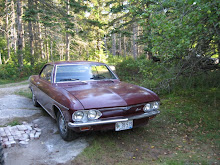
Yes, it's the little maroon one buried in the snow in this photo.

The decision to drive the Corvair on a work/vacation trip was not made lightly. I'd completed the trip in years past in my '66 Land Rover II-A and my '80 Triumph TR-7 Spider. Driving that same seven hours in the Land Rover had left my ears ringing, my body vibrating and my wallet lighter due to its 18 mpg. 

The same distance the following year in the TR-7 made for 25 mpg, less vibration, less assurance [it is a TR-7 after all] and a feeling that I'd sat in a space capsule for 6 hours. It also left me with a December dilemma at a Portland, ME motel one morning - how to get the door locks thawed out? The only successful method was to heat the key with the room's hair dryer so hot that it popped the circuit breaker in the dryer, then to run down two flights of stairs to insert the key into the lock before it cooled down. The second time was a charm.

So this year I felt the Corvair should do the honors. Work schedules meant that I could not allow myself an extra day [in case of breakdowns]; I would absolutely, positively have to get there on time on Saturday. My hesitation was based on the car's annoying habit of these past two years of wanting to die off on the side of the road when underway for an hour or more. No mechanic or Corvair expert had been able to figure out the source of this problem.

I booked the Corvair into the island's garage for the mechanic to check under the car. All the suspension pieces, steering components and wheel bearings seemed tight. I did the usual tune-up of points, condenser, rotor, distributor cap and spark plugs, and checked the timing. An oil/filter change had been done in October. I ordered a spare fan belt and fuel pump from Clark's and bought a used oil cooler from Maine's specialty shop, Maplewood Motors, in Cape Neddick. I packed tools, charged the cellphone and said a prayer.

On Friday I boarded the ferry for the 90 minute ride to the mainland and then started on my way south. I made it to Portland late that afternoon, booked myself into an inexpensive motel and then joined a group of Land Rover friends as the Sebago Brewpub in nearby Scarborough.  

Saturday morning I packed up again and headed out on the Maine Turnpike, to I-495 in Massachusetts and then onto the Mass Pike towards Connecticut. After stopping for fuel and water [for me, not the car], I started the car and noticed it did not want to accelerate out of the rest area. Just as it had done in the past it began to bog down instead of going faster. As I approached the turnpike entrance I wondered about proceeding ahead at all; you could not turn around and go back on the highway. Instead I plowed ahead and suddenly the car seemed to run on all 6 cylinders and both carburetors. This would happen again at a rest stop in Connecticut but other than that, the car ran flawlessly. Oh, and I got 28 mpg at 60-75 mph.

The car received a few odd stares and one memorable moment. On I-91 between Hartford and New Haven I drove in the center lane when I noticed a Mazda sedan, driven by a young guy, close to my rear bumper. I pulled over into the right lane and he followed me. When I looked in my rear view mirror I saw the passenger with a camera and noticed a flash. The car pulled up alongside me as they continued to take photos of the car from a few angles. Less surprising but equally pleasurable was a time when a new Corvette, with a man and a woman aboard, passed me as the the driver gave the Monza a "thumbs up."

Seat technology, particularly for "compact cars," had not advanced far in the 1960's. Add to this the reality that my driver's seat consisted of some crushed foam and a sheepskin seat cover and you wind up with an uncomfortable perch for a 6 hour drive. Also, as is often the case with rear engine cars the pedals sit a bit skewed towards the right; you feel as though your right leg is stretched out rather far to hold the accelerator towards the floor. This really became an issue on the trip home - more about that later.

While in Cos Cob my hosts noted they had seen a Corvair for sale and we visited it, right near Greenwich's public beach. A '68 convertible it looked good from a distance but showed some minor rust bubbles and mismatched paint up close. Nonetheless, it was still fun to see.

The late model convertible always looked terrific and in this light color, especially entertaining. To my dismay it had the s-l-o-w Powerglide 2-speed transmission and an aftermarket Edelbrock 4-barrel carb [instead of the 4-carb 140 hp setup implied by the air cleaner].


Still the two Corvairs looked pretty good together - they were clearly an unusual sight in this upscale village of Greenwich. 


My hostess told me of her cleaning woman's reaction to seeing the car in their driveway. The young woman, a recent immigrant from Poland, stared out the window to ask "whose car is that?" When she was told it was mine [we had met last year] she asked "he really drove it here?" "Yes,' my hostess replied, "from Maine." This astounded the woman, "he drove all the way from Maine? In that?" On the many winding residential streets of Cos Cob the Corvair really strutted its stuff.

The drive home to Maine really demonstrated the Corvair's capabilities. On the Friday I chose to drive home a powerful storm hit all of New England: heavy constant rain with winds from 40 - 55 mph. Rear-engine cars can tend to yaw in high crosswinds like this and, of course, any required repair in the pouring rain would be most un-fun.

As I drove northeast on the highways I came to realize the weather would not improve throughout the entire drive, that any truck passing the Corvair would engulf it sheets of rain and mist. Visibility would become a problem; as the car leaked a bit around the windshield, so, too would defrosting the windows.

I also realized that I had never driven this car in a significant, long-lived storm. I had no idea if the windshield wiper motor would run for 6 hours or whether the heater motor would function for that length of time. I found I had to open the vent window to assist in airflow the clear the left edge of the windshield. I stopped for fuel in Charlton, MA, along the Mass Pike, and then made it to New Hampshire and finally, Maine. The car, however, never faulted in speed or handling. While I could certainly feel the gusts of wind slam against the car, their shoves were handled easily by the excellent suspension. Everything worked the entire trip.

As I approached Portland I realized the winds had only strengthened and that I should find out if the Rockland-Vinalhaven ferry would even run that late afternoon. A quick phone call indicated "no" so I stopped in Portland for a break. Stepping out of the Corvair the wind shot rain onto my face with such force that the water drops hurt when they landed on me.

I continued on to Rockland and booked a motel room for the night. My right leg now felt like I had stretched a ligament or tendon around my right knee. I could not bend it very comfortably, whether seated or lying in bed. That's the aftereffect of the driver's seat - it should be reupholstered one day.

I know that many classic car owners avoid driving their cars in inclement weather - at times, myself included. This work/vacation trip showed me that the Corvair could be used as a daily driver in any weather. I still don't know the cause of the "bogging" [vapor lock?] after long drives but I now feel much more comfortable about jumping in the car and relying on it.

Oh, it passed the 130,000 mile mark during the trip.