LandRoverWriter.com

LandRoverWriter.com
The Land Rover Writer

Sunday, January 17, 2010

State Inspections


Maine requires that all vehicles except those registered as antiques must undergo an annual safety inspection. Cars over 25 years old can garner antique status; the insurance company I use does not impose mileage restrictions on antique cars.

So why not register all of my cars, which range in age from 30 - 44. as antiques? Maine has a Catch 22 - you cannot have all of your cars registered as antiques. At least one must be registered conventionally.

Annual inspections evoke love/hate feelings. It often feels like it's "stupid stuff" that fails a car: a failed side light, a tiny crack in the windshield, a bit of rust on a rocker panel, a noisy muffler. I mean, who cares? And the older your car, the more likely that one of these items, that don't really affect whether the car starts or stops, will cause a "failed inspection" notice. Besides, lots of states in the US, like Florida, don't even require inspections.

Last year, the Maine Legislature debated a bill that would have made inspection an every two year event, not yearly, and would have exempted cars under 2 years old. The bill failed after lots of debate. Given new car warranties and extended tire life of radial tires, the 2 year provision made a lot of sense.

Since too many people treat cars like appliances, I have to reluctantly approve of inspections - even though they throw me into a frenzy of fear every year. Todd, our local mechanic, puts every car on a lift and does the right thing. He yanks suspension components, watches for loose tie rod end as you turn the steering wheel, checks for brake pad and brake shoe condition [he will pull off a tire and brake drum if he has not done brake work on your car], tire wear, rocker panel and underbody rust [which are structural on unibody cars], and brake line and gas tank leaks.

He finds that our poor roads, salt water, salt in the air and on the roads, benign neglect of cars and trucks, and manufacturing practices by automakers means that a lot of cars start failing inspections. Since most drivers judge the condition of their car by the condition of the interior, quick starting and a working sound system, they can be incensed when they discover they have to replace a lot of brake lines.

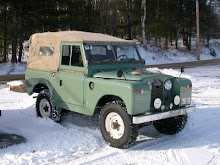
Not me - I am delighted when he find something unsafe on my cars. Even though I crawl underneath my cars all too often, I still don't catch everything as he can when the car is on a lift. So when the Land Rover went in last week for its inspection, he found loose bolts on the spring hangar plate he had replaced this summer and loose nuts on the propshaft where it attaches to the transmission brake. No wonder I had some odd noises on take off! He also spotted a tiny gas tank leak on an area I patched up last summer. I also have a ripped up wiper blade that needs replacement.

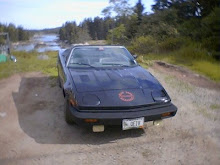
The TR-7 had its inspection the next day and it passed without incident. Again, having him underneath the car checking components and looking for rust really helped reassure me about the safe running of the car.

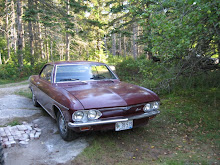
The Corvair and the other Land Rover, the QM I. are both registered as antiques so they avoid inspection, but that doesn't mean I can't pay to have him look underneath the cars for me so I know the work that's required to keep them on the road.

The British have an inspection requirement for all cars, regardless of age, called an MOT. British cars also undergo required emissions testing and in addition to all that we do in Maine, they require that cars don't leak any fluids of any sort! That would fail both the QE I and the QE IV, so I'm glad those British cars are in the US, and not in Jolly Olde.


Friday, December 25, 2009

29 Year Old Road Trip

At 29 I loved taking road trips. I've aged, but one car, my 1980 Triumph TR-7, is 29 and still eager to take a ride.

I hadn't the driven the TR much over the early winter, but when an invitation came to visit friends in Connecticut, I decided to make the drive south. The total time each way would be 90 minutes aboard the ferry and 6 1/2 hours on the highways to Fairfield County, CT. The weather forecasts called for sharply decreasing temperatures but unlikely precipitation.

The '66 Land Rover will always make the trip and get you home, but the QE I still has its canvas top [still waiting for a rear door before installing the hard top]. That makes it cold, in addition to noisy and 18 mpg. The TR-7 still gets 26-30 mpg even with 109,000 miles on the odometer, and unlike other TR's, has a real heater and ventilation system. Even with its convertible top, it's fairly tight and warm. I didn't have snow tires, but without a prediction of snow, all should be fine.

So I started up the Triumph and found that, after sitting for a few weeks, it would not idle. It also stalled out a lot. I limped to the local gas station, threw in some dry gas and fresh fuel, and ran the car around the island on a few errands. My trip was to start the next day, so I really hoped this was a temporary condition. I threw the toolkit in from the Corvair and got aboard the ferry the next day.

What could go wrong?

I decided to wash the car when I got to the mainland. After all, every enthusiast knows that a car runs better when it's clean. That night, the temperature dropped precipitously and a fierce wind picked up. So when I parked the car at a motel in Portland, the cold breezes froze up the door locks.

The next morning, I could not unlock the car. I bummed a book of matches from the desk clerk, wrapped a bunch of napkins into a wick and lit the whole thing like a Molotov cocktail. I held it under the key until it singed my fingers. No luck. I ran upstairs to the motel room, aimed the hair dryer at the key until the circuit breaker shut down, and then ran back downstairs with the flaming hot key. Finally, it melted the ice and let me unlock the doors.

On the 4 1/2 trip south, the car ran so well that even the FM radio suddenly started working again! That euphoria lasted until central MA when all radio signals seemed to fade away. I would not pick up a signal again until I crossed into Connecticut.

The last 50 miles of the trip was on the Merritt Parkway, one of the precursors to the interstate highway system. There it appears that the speed limit signs are only decorative; their numbers bear no resemblance to actual traveling speeds. Driving the stated speed limit is an open invitation to be run over.

The TR-7 does not have a GPS so I had to use directions written out on paper in order to find my friend's house. How quaint!

The trip back was a full 6 1/2 hours of relative comfort, stuffed into a TR-7. No wonder that Car and Driver magazine called it "the only sports car we would take on a long trip." For a British sports car without the name "Jaguar" on it, the wedge was remarkably comfortable.

Oh, yes, the car actually ran without incident for the full 600 miles and 13 hours of road time. Triumph used to say the TR-7 was "out to steal the American road." It certainly stole my heart again!

Saab: An oddball in peril - The Boston Globe

I can't think of a better way to writing my opinions about the demise of Saab than this editorial from the Boston Globe of Christmas Day, 2009:

Saab: An oddball in peril - The Boston Globe

Posted using ShareThis

Monday, October 19, 2009

Birthday Drives

Quechup | Blog: British Invasion

Shared via AddThis

It's my birthday today so, while working, I've decided to enjoy the day by making certain I drive each of my classic cars today.

So I took the TR-7 out on a ride to check in with a summer vacation house owner. Then I took the Land Rover out to the far end of the island to an estate there to effect a repair on a piece of mowing equipment.

This evening, I'll take a ride in the Corvair coupe just to relish a birthday ride [sadly, the local bar is closed on Mondays], and hopefully figure out what the squealing is from the rear.

Short of a wild night of romance, the cars will provide the best entertainment today.

Monday, March 30, 2009

Peugeot Gets It

US automotive industry observers, and the industry's political supporters, are mourning the forced removal of Rick Wagoner as the head of GM.

Although GM's share of the US marketed has fallen by 50% since he took over at the turn of this century, and the corporation's product offerings consistently demonstrated they appealed to fewer and fewer purchases, he had to be asked to leave as condition of continued federal support for the corporation.

It makes you wonder what the Board of Directors was thinking. Of course, most Boards wind up representing the interests of senior management; that's how you get invited to join a major Board. GM's Board has promised that next year, "you'll see a majority of new members."

PSA, the parent corporation of French automakers Peugeot and Citroen, removed their CEO this weekend because under his leadership, the automaker lost over 340 million Euros, or over $400 million. Their Board of Directors did not need a French government official to participate in a commission review of the company; they saw the existing leadership wasn't producing the desired results. Their new CEO comes from Corus Steel, so he might bring a fresh perspective to with the excellent engineering already on board with the company.

BTW, Corus is owned by Tata, the new parent for Land Rover and Jaguar.

No firing makes either Rick Wagoner or Christian Streiff reprehensible. No one should ever doubt the enormous energy and commitment it takes to run a giant corporation. Neither man went to his office each day looking for the easy way out. Automotive manufacturing is not an industry for the faint-hearted or intellectually deficient. The Donald Trumps of the automotive world might be entertaining to watch but they don't produce any better results than the Donald himself.

That said, the industry cannot pretend that its future operations will resemble the past ones. GM under Wagoner looked an awful lot like GM in the 1980's, and change was unlikely to occur on his watch.

Felicitations to PSA's Board for moving to make change on their own; let's hope that they're not just rearranging deck chairs on the Titanic.

Saturday, February 28, 2009

Why Minivans?

Since their first appearance in the US in the 1980's, minivans have become a symbol of automotive dorkdom. They offer many, many advantages in terms of comfort, carrying capacity, efficiency and ease of use. That's why I have no use for them. Give me a car with character anytime over an appliance.

For a minority - but growing percentage - of Americans, they seem to offer housing. An NPR reporter spent time in Florida this week and interviewed a 40-something man from Alabama. He had a good job for many years, lost it in the recession, couldn't make his house payments, and then became homeless.

So he and two friends now live in his minivan. The roominess of the minivan enables them to sleep in the car, albeit without great comfort. They're finding enough day labor to have food and gas but not enough to make deposits and rent an apartment.

He joins a lot of workers finding tough times in this employment market. Bob Herbert noted today that "
“What we’ve seen over the past eight years, for young people under 30, is the largest age reversal with regard to jobs that we’ve ever had in our history,” said Andrew Sum, the director of the Center for Labor Market Studies. “The younger you are, the more you got pushed out of this labor market.”

So the fellow with the minivan will be joined by a lot more people, and it looks like minivans will have an unfortunate role in this economy for a lot longer than we would want.

I have to admit; it would be hard to sleep in my TR-7.

Wednesday, February 25, 2009

Fill 'Er Up With Electricity?

This past week in Maine, over 145,000 homes lost power in a storm that began early Monday morning. Three days later, over 20,000 homes and businesses remain without electrical service. Regional power companies note that the high amount of snow, poor road conditions, and extreme weight of the moisture-laden snow all contributed to the slow restoration of power.

Am I the only one rethinking plug-in cars?

We lose power routinely enough in northern New England that we know to gas up the vehicles before the onset of a major storm. My 1966 Series II-A has a range of about 200 miles on its 12-gallon tank, and I can always fill additional gas cans should conditions become extreme. By the time I've travelled 200 miles, I can be reasonably certain that the power company has restored electrical power.

What if I had a plug-in car?

First off, I would be doing a lot of walking right now. Secondly, the surge on the power grid - thousands of owners charging up their cars all at once - would be enormous and likely unsustainable. Thirdly, a lot of goods and services would be undeliverable because we made the shift to plug-in electric cars before we constructed the infrastructure to support them.

Dutch Mandel of Autoweek has wisely noted that we could reduce our petroleum consumption by 1.5 million per day just by increasing the diesel fleet of our cars and trucks by 30%. Virtually all Land Rovers sold in the UK and Europe use diesel engines - you can't even get a Defender in the UK with a petrol engine. Across Europe, 53% of the cars sold are diesels; in the US, the diesel fleet constitutes 5% of all cars sold here.

Diesels burn cleaner overall than petrol engines, perform about the same, yet deliver up to 30% better mileage. The US would need to mesh its emissions standards to that of the EU in order for us to get more diesel powered cars here more rapidly, but once manufacturers have ramped up production for the US market, we could then jointly plan for emissions standards that meet both European and American concerns.

Yes, I know you could start up the home generator to produce electricity to plug in your hybrid, but doesn't that defeat the purpose?

Thursday, February 12, 2009

Cupid, Draw Back Your Bow!


Let's see, this is a busy weekend in Maine. As everywhere else, it's Valentine's Day on Sunday, and for some, a paid holiday on Monday. So what could I do that would enchant a woman to a weekend of romance?

I know from radio notices that Renee Fleming, the "people's diva" and world famous opera singer, will perform with the Portland Symphony this weekend. That would show my ineffable class, as befits someone who drives a Corvair Monza Coupe. What a perfect car to arrive in at the opera with a stunning date! I can envision myself handing the keys to the valet parking attendant as he gazes in awe at the European lines of the brilliant car. Then he'll start it up and hear the loud tapping of hydraulic lifter seaching for oil and the howl of the air-cooled engine's fan. And I'll have to warn him about the tear in the driver's seat. No, I'll pass on the opera this time. If a Corvair at speed is a bit noisy, what's a soprano at full trill going to sound like?

Even if I took the TR-7, issues would inevitably arise. While I find the thought of a stunning woman exiting from a low slung sports car enticing, some women do not; they use phrases like "Lecher!" whenever I propose taking the Triumph. It's intimate but there are limits of what you can do inside a TR-7.

So if I cannot lure a date with an evening indoors, why not a day spent in Maine's great woods? What says love more than a weekend of off-roading in a Land Rover? This is the weekend of the Maine Winter Romp, now in it's 13th year. Over 100 Land Rovers from New England, New York, New Jersey, Pennsylvania, and the Maritime Provinces of Canada will likely attend; last year, one fellow drove his Series II-A from Ohio! The total group might be more than 250 people. Nothing says love moreby than huddling together in a Land Rover, Range Rover, Discovery or LR3, on trails that run through the woods, streams, hills and bogs of Unity, Maine.

The cars range from utterly stock, like mine, to fully equipped with locking differentials, jacked up suspensions and 12,000 lb. winches. The attendees range in age from 9 months [Sophia, who rode in my 1966 Land Rover last year] to 70. While the trails are usually broken down by a skidder, or by snowmobiles, in advace, we never know just what conditions we will encounter. Last year the trails had some very deep ruts and a few watery sinkholes. The sides of the trails - the places we had to walk with winch cables to find a purchase spot - were easily thigh deep. Walking in snow that's brushing your crotch gets old fast. It does keep your attention on the task on hand, however.

There are hard core enthusiasts who use the opportunity to camp in cold lean-to's for the weekend. Given that temperatures at night have ranged from -20F to +32 F, I've opted to stay at the "Romp Hotel," a Holiday Inn in nearby Waterville, ME. It has heat to dry out your clothes, a table on which you can disassemble any part in comfort and plenty of towels to clean off your greasy hands. How could a woman say "no?"

I admit that I've run into some resistance with my invitations for this romantic weekend. Oh well, I'll see if Cupid has other plans for me on the trails.

Saturday, January 31, 2009

Lucked Out

My personal "garage" has extraordinary ventilation, limited ceiling height and plenty of stretch out room. It's a bit cold [or hot, depending on season] but if the sun's out, lots of light. That's because it's a classic, open air "shade tree" garage.

In Maine open air maintenance work can get uncomfortable this time of year. So when the linemen who work for FIEC, our local electric co-op, I jumped at the chance to get my cars up to snuff mechanically. First up was my 1966 Corvair Monza Coupe with the 110 hp/4 speed drivetrain.

I had bought tune-up parts at Clark's Corvairs when the Bay State club held its wonderful Rally there back in September but had unwisely left them sitting in the Clark's bag since then. The car had soldiered on nicely this winter, but I knew it was time for the minor tune-up.

So I enjoyed the warmth of a heated, concrete floored building, with drop lights, a huge floor jack, jack stands, and at the end of the workday, several linemen, fishermen, a plumber, a carpenter and two dogs to watch me, give advice, and comment on my numerous shortcomings. All but one were younger, by decades, than me. Did I mention there were "beverages" cooling in the snowbank just outside the door?

The Monza drew many compliments. Everyone thought it had great style, despite its scabrous paint job. I had a nice conversation with the plumber about engine [the P.O. had once offered him the chance to drive the car at a time when it had no brakes - he still shudders at the ride]. We agreed that it was very clever.

I agreed to let one man and his wife, who had never been in a Corvair, take the car one afternoon this spring or summer to enjoy a warm weather drive in it.

So I swapped out the points, rotor and condenser. The Clark's distributor cap on the car was the brass contact model; the one I purchased at Clark's had the aluminum contacts. Since the brass one looked perfect, I left it in place and put the new one in the trunk. When I went to restart the car, it would not, so I checked my point gap again - too wide. Once adjusted correctly it started up right away and purred.

Swapping plugs always gives you a chance to examine the engine's condition. I had last changed them in November 2007. The mayo in the air cleaner made it clear that the car's oil [changed in November] had condensation in it; I'm just not going far enough each time I drive the car. Plug #1 was wet and a bit gunked up, the others on the right bank were a bit wet but without evidence of much oil. The left bank plugs were all just brown and worn out. So I was relieved that all seemed well enough for the 123,000 mile engine that shows no evidence of being apart since new.

Last was a grease job on the front end. As I took out my pistol grip grease gun, a roar of derision rose and the line crew foreman handed me their battery operated grease gun, one that uses a small electric motor to pump the grease. If I had a lot of greasing to do, it would be slick to use; as it was, a few seconds with the electric gun filled everything just fine.

So the Monza runs great, will certainly start that much better, gained new appreciation from locals, provided me with a satisfying few hours, and the heat of a waste-oil furnace as well as the heat of satirical ridicule.

What a great way to pass a late afternoon.

www.landroverwriter.com

Thursday, January 15, 2009

Twin Spokesmen With Opposite Messages


Two veteran actors passed away recently. Both proved to be spokesmen for opposite approaches to building and selling automobiles.

Patrick McGoohan, the English actor who gained television fame in "Secret Agent Man" one of the finest Columbo episodes ever [it's the "urinal" episode], and "The Prisoner." The latter took "The Avengers" and swept away the humor. It spoke of a dark world in which a character, known only as Number 6, tries to figure out who he is and where he is being held; it's a mix of drama and science fiction. In the manner of great British series of the '60's, only 17 episodes were made, despite its commercial success on the air.

The signature opening of the show was McGoohan [presumably] in a Lotus 7, a tiny, light, cycle fendered sports car, that in the '860's of American cars, looked like an escapee from a carnival ride. They handled better than most race cars, offered minimal interior comfort, had hankie-in-the-wind tops and flapping side curtains. They weighed about as much as a Twinkie so their small engines could still propel them to fantastic speeds. Your passenger, should they be brave, sat about 2 inches to your right and still could barely hear you over the roar of wind, engine and transmission.

When McGoohan died recently and media commentators spoke of his career [his last big role was in Braveheart], they went right to the visual impact of this little car speeding down a road on a quest for freedom. To drivers of any American car, the Lotus 7 was an impossible consideration as transportation. I still want one.

Its antithesis was the Chrysler Cordoba,hawked on television and print in a memorable advertising campaign.

Ricardo Montalban, notorious for his role on Fantasy Island and as an evil warrior in Star Trek movies, rose to fame in movies as one of the first Mexican-born leading men in US films. For the automotive world, his timeless notoriety came out of his time as a spokesman for the Chrysler Cordoba, a "personal luxury car" for the '70's.

The Cordoba resembled something you would design in study hall if you had come to school stoned. The car featured one wretched excess after another: a garish grille; a wide body stance that from the rear, looked like an offensive guard on an NFL team; a vinyl roof; more bling than an NBA draft choice; and two doors too big for most barns. That said, the car sold awfully well during the decades that cemented Detroit's current reputation for unsalable cars.

But it was the interior that made Montalban's career as a car spokesman. In a hard-to-believe accent, Montalban extolled interiors of "fine Corinthian leather." Decked out in a suit that only a "Saturday Night Fever" extra could love, in a shirt with collar points larger than the wings on a 747, he let his tongue trill over the word "Corinthian." Clearly buyers sweated bullets in their polyester suits and headed right for the dealership. Except, of course, there's no such thing as "Corinthian leather." The seats were just a fancy vinyl.

How opposite the messages presented by these two spokesmen, now sadly departed.