
There was a great article in the New York Times Sunday edition recently. A fellow from New Jersey really liked his late '70's Mercedes 300 D diesel. It ran wonderfully and it seemed to be built like a tank. So he kept his eyes open and wound up buying two more: one for his wife and one to keep at a vacation home in Vermont. They're similar cars from the late '70's-early 80's.
The owners says he's 50 years old which means he'll probably never have to buy another car in his lifetime. He sounds very pleased with his approach.
His total costs of purchase are less than a Nissan Versa. By virtue of age and original price, his registration fees/excise taxes and insurance are substantially less than they would be with new cars.
They have high mileage but as Mercedes diesels, they'll run for a long time. Parts support remains great so the cars are never tied up for parts. This is in sharp contrast to a friend's VW Jetta, which has sat at our local mechanics shop for 10 days waiting for the VW dealer on the mainland to actually get him a heater motor. You'd think that in New England, which has real winters, dealers would have adequate access to something as critical as a heater blower motor - not so.
With classic cars you give up many active aids to crash safety, so guess what - you have to drive with greater care. Classic cars have plenty of passive safety features built into their designs, but of course, they were designed during a time that it was assumed the whole idea of driving was avoiding accidents.
If you don't want to, or can't, work on them yourself, you'll help the national economy by moving parts [which then must be manufactured somewhere], keeping local mechanics employed, and actually buying something you can afford.
Think about it - now's the time to change and enjoy that classic car you've always wanted. If you have to drive, why not make it fun?
Showing posts with label national politics. Show all posts
Showing posts with label national politics. Show all posts
Tuesday, January 6, 2009


Tuesday, December 30, 2008
Now What?
GMAC has received $1 billion, benefiting GM, Chrysler and GMAC itself. Now what?
It's a shame the GMAC management chose to invest in mortgage securities to earn more money, because the credit arm of GM [Cerebrus owns a portion of GMAC, which helps Chrysler, too] is really needed right now. For those Americans who have a secure job with a steady income[freelancers like me do not], this is a pretty good time to buy a new car. Of course, at today's car prices - $28,000 average price - most people need some credit assistance. At a time of a credit crunch, it's proving to be very hard to get access to leases and/or loans. So a lot of buyers are disappointed and a lot dealers have excess inventory and a lot of manufacturers have cars sitting by the factory for 100 days at a time.
Congress has asked a simple question of the banks that received the first $350 billion bailout -what has your business done with the bailout money- only to discover that most can't or won't tell them. Hmm...
So my hope for GMAC is that it will be very transparent [I know it is not required, as a newly-converted bank, to actually tell Congress what you're doing with taxpayer money] and very, very eager to extend financing. There are a lot of buyers who purchased cars whose value decreased before their loans came due. So you owe more money than the car is worth - ouch! I'm no fan of contemporary cars but I do support a vibrant domestic auto industry for those who do want their new cars.
Do not use this loan to fatten up the balance sheet for a sale!Tuesday, December 23, 2008
The New Duke of Deception
In 1979 Geoffrey Wolfe wrote The Duke of Deception, a memoir of his life with his father, a master con artist. Arthur Wolfe - one of his several aliases - created a persona about himself that enabled him to live a life far beyond his means. He never shared his con with his family so their discovery of the truth provides the core of the book.
One hallmark of Arthur's life was the possession of the sports cars of his era, from MG's to Jaguars. Turns out it was one of his first post-war purchases. In their time these largely British sports cars helped define visually the man who could afford carefree driving; if it required maintenance, there would be a mechanic on call or he would have the time to fix it himself. You could be your own country squire, the gentleman sportsman, right here in America.
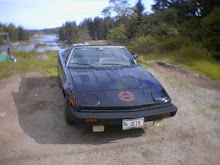
We loved the imagery of the lifestyle and we loved the cars themselves; they sold in far greater numbers here than they ever did in Great Britain. My first exciting drive was in an MGB-GT; while I drove it with care, the owner drove it with abandon just to show me what they could do. I pined away for one and finally, in 1968, bought my first Triumph Spitfire for $600. I've never been without a British sports car since then; now, it's a 1980 Triumph TR-7 Spider.
So it was no surprise to me that when the Boston Globe did a front page story [12/21/08] on the "connection" to the scam artist Bernard Madoff, a money manager named Robert Jaffee, they pictured him in his concours-level MG-TF, impeccably coiffed and dressed [he did not plan on getting greasy!]. The photo was first taken by the Palm Beach Daily News.
Two cheers for the new Duke of Deception.
Tuesday, December 16, 2008
Small Cars = Cheap Cars: Only in Detroit
Over the decades Detroit manufacturers have worked with the following equation: large cars = great cars, small cars = cheap cars. So no one really engineered or marketed a small car to be a great car.
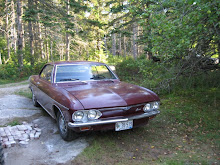
Well, actually, by accident, Chevrolet did when they created my beloved Corvair. Without realizing it they made the Corvair a far better car - unibody, low stressed air cooled engine, superb styling in either early or late guise, great seating capacity - than other "compacts." But at the same time, they sought to sell it on low price alone. So the interiors were cheezy, a passenger side sun visor and heater were optional, marketing was aimed at economy, build quality in the later models was appalling, even by '60's standards, and so on.
But European manufacturers long ago recognized that the laws of physics affect automobiles, too. So why not make an elegant, superbly designed small car? They used the registration and tax laws to their advantage. If gas taxes are quite high [now about $3.80 per gallon according to the Boston Globe], why not make engines fuel efficient? Why not make 4-5-6 speed transmissions so those same engines can propel the cars to autobahn speeds? Since they'll be going much faster than Americans do on their highways, we'd better give them great suspensions and handling packages. And Europeans are less likely to own multiple cars so they made them with higher quality so they would last.
The European models that could not make it in the US were the Renault Dauphines and Fiat 500's, the economy cars with tiny engines [<1>
Friday, December 12, 2008
City to Ford: Drop Dead
In 1975, the New York Post paraphrased President Gerald Ford's decision not to provide federal bailout assistance to New York as "Ford to City: Drop Dead."
So today, we can paraphrase Washington's decision [thank you, Senate Republican leadership] not to assist the Detroit automakers as "City to Ford: Drop Dead."
What a great boost to the economies of states with automotive-related industries, worker income taxes, auto excise taxes, sales taxes, dealerships - any states come to mind, like yours?
Thursday, December 11, 2008
Senate Republicans Fiddle While Detroit Burns
I took the ferry to the mainland from this Maine island this morning but made it home this afternoon to note that the Senate Republicans have decided to defy their President, the House of Representatives, and a wide array of economists and Wall St. experts. The bailout bill for GM and Chrysler [and Ford if they need it] looks doomed.
What's fascinating here is the hypocrisy. Senators from states that have offered huge incentives for foreign manufacturers to establish factories there refuse to assist American-based companies whose factories happen to be in other states. Maine's two Republican Senators have appropriately asked lots of questions and demand accountability, but they have not yet sounded nonsensical.
What part of "one nation" don't they understand? Maybe one of them can explain just why throwing hundreds of thousands of new people out of work is such a great idea?
Subscribe to:
Posts (Atom)




 Posts

