LandRoverWriter.com

LandRoverWriter.com
The Land Rover Writer
Showing posts with label automotive industry. Show all posts

Friday, January 14, 2011

A Man After My Own Heart


Here's a man after my own heart - a classic car enthusiast who's decided to drive his Model A Ford as his daily driver for a year.

His most recent trip is chronicled here.

I've owned one new car in my life, a 1972 Siimca. Once in the '70's, with a '74 VW Beetle Convertible, and twice in the 1980's, with two Jeep CJ's, I've bought cars manufactured in the same decade as my purchase of them. Otherwise, I've always run very used classic cars as daily drivers.

That has not been without incident, but as Jonathan Klinger maintains in the column above, there's a connection to your landscape, a self-reliance, and a connection to machinery that comes from relying on a classic car rather than just waxing it or writing checks to restorers and mechanics.

Bravo, Jonathan, and keep up your quest!


Wednesday, January 12, 2011

Chrysler = Lancia?

Autoweek reports that Fiat is going to take the "new" Chrysler 200 and call it a Lancia in Europe.

The Lancia version will come in both the clunky sedan and the antiquated, unsporting convertible. A Chrysler 300 and even a minivan version might appear next year.

Considering that Lancia is generally acknowledged to have built the first GT, and that its vehicles exported here in the 60's and '70's were superbly engineered sports cars and GT's, this move strikes me as pathetic.

I know that Fiat saved Lancia. I know that Fiat saved Chrysler. The Chrysler name in Europe must be mud after their fiascoes with Rootes and Simca. Surely importing mediocre sedans - the 300 needs to shed weight - is not the answer for Fiat.

And we want real Fiats and real Lancias and real Alfa Romeo's back here.

Monday, March 30, 2009

Peugeot Gets It

US automotive industry observers, and the industry's political supporters, are mourning the forced removal of Rick Wagoner as the head of GM.

Although GM's share of the US marketed has fallen by 50% since he took over at the turn of this century, and the corporation's product offerings consistently demonstrated they appealed to fewer and fewer purchases, he had to be asked to leave as condition of continued federal support for the corporation.

It makes you wonder what the Board of Directors was thinking. Of course, most Boards wind up representing the interests of senior management; that's how you get invited to join a major Board. GM's Board has promised that next year, "you'll see a majority of new members."

PSA, the parent corporation of French automakers Peugeot and Citroen, removed their CEO this weekend because under his leadership, the automaker lost over 340 million Euros, or over $400 million. Their Board of Directors did not need a French government official to participate in a commission review of the company; they saw the existing leadership wasn't producing the desired results. Their new CEO comes from Corus Steel, so he might bring a fresh perspective to with the excellent engineering already on board with the company.

BTW, Corus is owned by Tata, the new parent for Land Rover and Jaguar.

No firing makes either Rick Wagoner or Christian Streiff reprehensible. No one should ever doubt the enormous energy and commitment it takes to run a giant corporation. Neither man went to his office each day looking for the easy way out. Automotive manufacturing is not an industry for the faint-hearted or intellectually deficient. The Donald Trumps of the automotive world might be entertaining to watch but they don't produce any better results than the Donald himself.

That said, the industry cannot pretend that its future operations will resemble the past ones. GM under Wagoner looked an awful lot like GM in the 1980's, and change was unlikely to occur on his watch.

Felicitations to PSA's Board for moving to make change on their own; let's hope that they're not just rearranging deck chairs on the Titanic.

Saturday, February 28, 2009

Why Minivans?

Since their first appearance in the US in the 1980's, minivans have become a symbol of automotive dorkdom. They offer many, many advantages in terms of comfort, carrying capacity, efficiency and ease of use. That's why I have no use for them. Give me a car with character anytime over an appliance.

For a minority - but growing percentage - of Americans, they seem to offer housing. An NPR reporter spent time in Florida this week and interviewed a 40-something man from Alabama. He had a good job for many years, lost it in the recession, couldn't make his house payments, and then became homeless.

So he and two friends now live in his minivan. The roominess of the minivan enables them to sleep in the car, albeit without great comfort. They're finding enough day labor to have food and gas but not enough to make deposits and rent an apartment.

He joins a lot of workers finding tough times in this employment market. Bob Herbert noted today that "
“What we’ve seen over the past eight years, for young people under 30, is the largest age reversal with regard to jobs that we’ve ever had in our history,” said Andrew Sum, the director of the Center for Labor Market Studies. “The younger you are, the more you got pushed out of this labor market.”

So the fellow with the minivan will be joined by a lot more people, and it looks like minivans will have an unfortunate role in this economy for a lot longer than we would want.

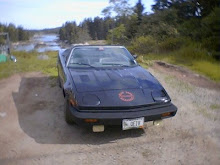
I have to admit; it would be hard to sleep in my TR-7.

Saturday, January 31, 2009

Lucked Out

My personal "garage" has extraordinary ventilation, limited ceiling height and plenty of stretch out room. It's a bit cold [or hot, depending on season] but if the sun's out, lots of light. That's because it's a classic, open air "shade tree" garage.

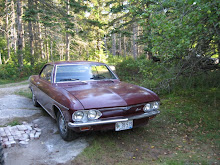
In Maine open air maintenance work can get uncomfortable this time of year. So when the linemen who work for FIEC, our local electric co-op, I jumped at the chance to get my cars up to snuff mechanically. First up was my 1966 Corvair Monza Coupe with the 110 hp/4 speed drivetrain.

I had bought tune-up parts at Clark's Corvairs when the Bay State club held its wonderful Rally there back in September but had unwisely left them sitting in the Clark's bag since then. The car had soldiered on nicely this winter, but I knew it was time for the minor tune-up.

So I enjoyed the warmth of a heated, concrete floored building, with drop lights, a huge floor jack, jack stands, and at the end of the workday, several linemen, fishermen, a plumber, a carpenter and two dogs to watch me, give advice, and comment on my numerous shortcomings. All but one were younger, by decades, than me. Did I mention there were "beverages" cooling in the snowbank just outside the door?

The Monza drew many compliments. Everyone thought it had great style, despite its scabrous paint job. I had a nice conversation with the plumber about engine [the P.O. had once offered him the chance to drive the car at a time when it had no brakes - he still shudders at the ride]. We agreed that it was very clever.

I agreed to let one man and his wife, who had never been in a Corvair, take the car one afternoon this spring or summer to enjoy a warm weather drive in it.

So I swapped out the points, rotor and condenser. The Clark's distributor cap on the car was the brass contact model; the one I purchased at Clark's had the aluminum contacts. Since the brass one looked perfect, I left it in place and put the new one in the trunk. When I went to restart the car, it would not, so I checked my point gap again - too wide. Once adjusted correctly it started up right away and purred.

Swapping plugs always gives you a chance to examine the engine's condition. I had last changed them in November 2007. The mayo in the air cleaner made it clear that the car's oil [changed in November] had condensation in it; I'm just not going far enough each time I drive the car. Plug #1 was wet and a bit gunked up, the others on the right bank were a bit wet but without evidence of much oil. The left bank plugs were all just brown and worn out. So I was relieved that all seemed well enough for the 123,000 mile engine that shows no evidence of being apart since new.

Last was a grease job on the front end. As I took out my pistol grip grease gun, a roar of derision rose and the line crew foreman handed me their battery operated grease gun, one that uses a small electric motor to pump the grease. If I had a lot of greasing to do, it would be slick to use; as it was, a few seconds with the electric gun filled everything just fine.

So the Monza runs great, will certainly start that much better, gained new appreciation from locals, provided me with a satisfying few hours, and the heat of a waste-oil furnace as well as the heat of satirical ridicule.

What a great way to pass a late afternoon.

www.landroverwriter.com

Thursday, January 15, 2009

Twin Spokesmen With Opposite Messages


Two veteran actors passed away recently. Both proved to be spokesmen for opposite approaches to building and selling automobiles.

Patrick McGoohan, the English actor who gained television fame in "Secret Agent Man" one of the finest Columbo episodes ever [it's the "urinal" episode], and "The Prisoner." The latter took "The Avengers" and swept away the humor. It spoke of a dark world in which a character, known only as Number 6, tries to figure out who he is and where he is being held; it's a mix of drama and science fiction. In the manner of great British series of the '60's, only 17 episodes were made, despite its commercial success on the air.

The signature opening of the show was McGoohan [presumably] in a Lotus 7, a tiny, light, cycle fendered sports car, that in the '860's of American cars, looked like an escapee from a carnival ride. They handled better than most race cars, offered minimal interior comfort, had hankie-in-the-wind tops and flapping side curtains. They weighed about as much as a Twinkie so their small engines could still propel them to fantastic speeds. Your passenger, should they be brave, sat about 2 inches to your right and still could barely hear you over the roar of wind, engine and transmission.

When McGoohan died recently and media commentators spoke of his career [his last big role was in Braveheart], they went right to the visual impact of this little car speeding down a road on a quest for freedom. To drivers of any American car, the Lotus 7 was an impossible consideration as transportation. I still want one.

Its antithesis was the Chrysler Cordoba,hawked on television and print in a memorable advertising campaign.

Ricardo Montalban, notorious for his role on Fantasy Island and as an evil warrior in Star Trek movies, rose to fame in movies as one of the first Mexican-born leading men in US films. For the automotive world, his timeless notoriety came out of his time as a spokesman for the Chrysler Cordoba, a "personal luxury car" for the '70's.

The Cordoba resembled something you would design in study hall if you had come to school stoned. The car featured one wretched excess after another: a garish grille; a wide body stance that from the rear, looked like an offensive guard on an NFL team; a vinyl roof; more bling than an NBA draft choice; and two doors too big for most barns. That said, the car sold awfully well during the decades that cemented Detroit's current reputation for unsalable cars.

But it was the interior that made Montalban's career as a car spokesman. In a hard-to-believe accent, Montalban extolled interiors of "fine Corinthian leather." Decked out in a suit that only a "Saturday Night Fever" extra could love, in a shirt with collar points larger than the wings on a 747, he let his tongue trill over the word "Corinthian." Clearly buyers sweated bullets in their polyester suits and headed right for the dealership. Except, of course, there's no such thing as "Corinthian leather." The seats were just a fancy vinyl.

How opposite the messages presented by these two spokesmen, now sadly departed.

Wednesday, January 14, 2009

Zut Alors - Une Jeep Francaise?

Just like Land Rover, ownership of Jeep has become a sort of holy grail for automobile companies. Regardless of the corporate parent, the two marques seem to "Carry On, Jeeves," with their own enthusiasts bolstering sales and building brand awareness.

Now the rumors abound that Renault, and its partner Nissan, are toying with making a bid for Jeep from Chrysler. This will complete a circle.

Renault once sold a lot of cars here, with the Dauphine model in the '60's, but it's propensity to overheat and blow head gaskets reduced sales over time. Even though the cars got a lot better - the Renault 5, 12, 16, 17, 18, Fuego - and sold very well in Europe, they just did not capture American hearts. By the '70's, Renault was hiring USAC race drivers like Bobby and Al Unser for tv and print ads extolling the virtues of the Renault 12. In the '80's, Renault bought up the remnants of American Motors, which included Jeep.

One problem for Renault was the dealer network, a small collection of out-of-the-way dealers in smaller markets. When they showed up in major cities the dealers combined them with other makes; they rarely showed up in stand-alone locations. Renault had visions of American Motors dealers now selling Renaults, Jeeps, and the remaining line of American Motors, the Eagle.

Eventually Renault produced the Alliance and the Encore, two cars oriented to the American market. They sold in modest numbers but never broke through. Eventually Renault sold off the remaining American Motors assets - and Jeep - to Chrysler.

The opportunities presented by Jeep - like Land Rover - to larger manufacturers lie in their name recognition, established technology, enthusiast base, and name recognition. It's very alluring to a succession of owners; in recent decades, BMW, Ford and now Tata have adopted Land Rover.

Could there be some elan in Jeep's future? It would be interesting to see some of Nissan's successful engineering incorporating Jeep's 4WD experience. Renault rescued Nissan and made it successful again; maybe together they will work their magic on Jeep.

Tuesday, January 6, 2009

Run Your Classic Car Everyday

There was a great article in the New York Times Sunday edition recently. A fellow from New Jersey really liked his late '70's Mercedes 300 D diesel. It ran wonderfully and it seemed to be built like a tank. So he kept his eyes open and wound up buying two more: one for his wife and one to keep at a vacation home in Vermont. They're similar cars from the late '70's-early 80's.

The owners says he's 50 years old which means he'll probably never have to buy another car in his lifetime. He sounds very pleased with his approach.

His total costs of purchase are less than a Nissan Versa. By virtue of age and original price, his registration fees/excise taxes and insurance are substantially less than they would be with new cars.

They have high mileage but as Mercedes diesels, they'll run for a long time. Parts support remains great so the cars are never tied up for parts. This is in sharp contrast to a friend's VW Jetta, which has sat at our local mechanics shop for 10 days waiting for the VW dealer on the mainland to actually get him a heater motor. You'd think that in New England, which has real winters, dealers would have adequate access to something as critical as a heater blower motor - not so.

With classic cars you give up many active aids to crash safety, so guess what - you have to drive with greater care. Classic cars have plenty of passive safety features built into their designs, but of course, they were designed during a time that it was assumed the whole idea of driving was avoiding accidents.

If you don't want to, or can't, work on them yourself, you'll help the national economy by moving parts [which then must be manufactured somewhere], keeping local mechanics employed, and actually buying something you can afford.

Think about it - now's the time to change and enjoy that classic car you've always wanted. If you have to drive, why not make it fun?


Tuesday, December 30, 2008

Now What?

GMAC has received $1 billion, benefiting GM, Chrysler and GMAC itself. Now what?

It's a shame the GMAC management chose to invest in mortgage securities to earn more money, because the credit arm of GM [Cerebrus owns a portion of GMAC, which helps Chrysler, too] is really needed right now. For those Americans who have a secure job with a steady income[freelancers like me do not], this is a pretty good time to buy a new car. Of course, at today's car prices - $28,000 average price - most people need some credit assistance. At a time of a credit crunch, it's proving to be very hard to get access to leases and/or loans. So a lot of buyers are disappointed and a lot dealers have excess inventory and a lot of manufacturers have cars sitting by the factory for 100 days at a time.

Congress has asked a simple question of the banks that received the first $350 billion bailout -what has your business done with the bailout money- only to discover that most can't or won't tell them. Hmm...

So my hope for GMAC is that it will be very transparent [I know it is not required, as a newly-converted bank, to actually tell Congress what you're doing with taxpayer money] and very, very eager to extend financing. There are a lot of buyers who purchased cars whose value decreased before their loans came due. So you owe more money than the car is worth - ouch! I'm no fan of contemporary cars but I do support a vibrant domestic auto industry for those who do want their new cars.

Do not use this loan to fatten up the balance sheet for a sale!

Tuesday, December 23, 2008

The New Duke of Deception

In 1979 Geoffrey Wolfe wrote The Duke of Deception, a memoir of his life with his father, a master con artist. Arthur Wolfe - one of his several aliases - created a persona about himself that enabled him to live a life far beyond his means. He never shared his con with his family so their discovery of the truth provides the core of the book.

One hallmark of Arthur's life was the possession of the sports cars of his era, from MG's to Jaguars. Turns out it was one of his first post-war purchases. In their time these largely British sports cars helped define visually the man who could afford carefree driving; if it required maintenance, there would be a mechanic on call or he would have the time to fix it himself. You could be your own country squire, the gentleman sportsman, right here in America.

We loved the imagery of the lifestyle and we loved the cars themselves; they sold in far greater numbers here than they ever did in Great Britain. My first exciting drive was in an MGB-GT; while I drove it with care, the owner drove it with abandon just to show me what they could do. I pined away for one and finally, in 1968, bought my first Triumph Spitfire for $600. I've never been without a British sports car since then; now, it's a 1980 Triumph TR-7 Spider.

So it was no surprise to me that when the Boston Globe did a front page story [12/21/08] on the "connection" to the scam artist Bernard Madoff, a money manager named Robert Jaffee, they pictured him in his concours-level MG-TF, impeccably coiffed and dressed [he did not plan on getting greasy!]. The photo was first taken by the Palm Beach Daily News.

Two cheers for the new Duke of Deception.

Sunday, December 21, 2008

Why I Love Winter

It's 4 days before Christmas and like a lot of the country, Maine lies underneath over a foot of snow. It will be a White Christmas The snow will continue all evening and throughout the night. I can hear the house moaning in the high winds. As this is an island town, there's no question that the ferry boats to the mainland will not run much of the day.

I have a cellar full of firewood and food that can be heated on the woodstove if necessary. I'm trying to get this blog finished before we lose power.

The driving is frightful right now, but earlier, heading out in either of my 1966 cars showed what enduring engineering is all about. The Corvair, with its rear engine, rear wheel drive, combines superb traction, excellent driver feedback and light weight to prove a great winter car. You always know, because you can feel it, where the wheels are planting themselves on every inch of roadway. With a wheelbase of only 108", you can feel any incipient skid and make corrections in plenty of time.

I drove around the very slippery, very windy roads here during the day, on a church run and a dump run, and felt in complete control the entire time. Unless the belly pan of the car high-centers on deep snow, it won't get stuck. All I'm running is ordinary snow tires on the rear, too.

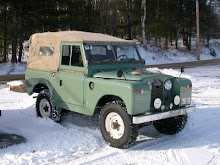
When I needed to get into the woods to get more firewood, it was easy with the Land Rover. With its superb gearing, it won't get stuck unless it high centers on a snowbank or drops into a snow covered ditch. The car only has an 88" wheelbase but it will carry a lot of firewood in its square dimensioned body.

These cars are 42 years old in construction and engineering, but because they do not try and isolate you from the road - they connect you instad - you know exactly what's happening on a winter's day. Precision and connectivity will win out over electronic aids any time - I wonder if GM or Land Rover are listening?

Thursday, December 18, 2008

Britain Gets It Right

The government of Gordon Brown recognizes the importance of the automotive manufacturing industry to his country. Even though the number of British-based automobile companies is small, the number of plants - regardless of corporate ownership - is deemed important.

Jaguar and Land Rover are now a single company, owned by the Tata conglomerate in India. The merged corporate structure pays 15,000 workers a year; its collective impact on far more workers [sales, repair shops, parts manufacturers and retailers] is even larger.

Great Britain has led the world in seeking out effective solutions to the banking/lending crisis; indeed, it wasn't long after Secretary Paulson announced his $700 billion plan that the Brown government came up with an alternative plans. By all measures theirs has worked better than ours.

So I was not surprised to read that when Jaguar and Land Rover found that they needed support in this difficult automotive environment, their government listened and indeed appears ready to act. Meanwhile, Washington continues to suck air as it approaches the end of December - when GM and Chrysler will run out of funds.

Wednesday, December 17, 2008

So You Think That Detroit was Faking It?

So you - yes, you, Senate southern Republicans - think that Detroit is faking their financial distress? I don't thnk so.

You see, according to the Assoicated Press, all 30 Chrysler plants in the US will shut down this Friday and remain closed until January 19. That's a great way to conserve funds and reduce inventory. Of course, a lot of auto workers, blue collar and white collar, will no longer have the same paycheck or will go on unemployment. That should do wonders from strapped state unenployment funds.

Well, good thing that the Senate Republicans refused to be bamboozled by those Big 3 CEO's.

Tuesday, December 16, 2008

Small Cars = Cheap Cars: Only in Detroit

Over the decades Detroit manufacturers have worked with the following equation: large cars = great cars, small cars = cheap cars. So no one really engineered or marketed a small car to be a great car.

Well, actually, by accident, Chevrolet did when they created my beloved Corvair. Without realizing it they made the Corvair a far better car - unibody, low stressed air cooled engine, superb styling in either early or late guise, great seating capacity - than other "compacts." But at the same time, they sought to sell it on low price alone. So the interiors were cheezy, a passenger side sun visor and heater were optional, marketing was aimed at economy, build quality in the later models was appalling, even by '60's standards, and so on.

But European manufacturers long ago recognized that the laws of physics affect automobiles, too. So why not make an elegant, superbly designed small car? They used the registration and tax laws to their advantage. If gas taxes are quite high [now about $3.80 per gallon according to the Boston Globe], why not make engines fuel efficient? Why not make 4-5-6 speed transmissions so those same engines can propel the cars to autobahn speeds? Since they'll be going much faster than Americans do on their highways, we'd better give them great suspensions and handling packages. And Europeans are less likely to own multiple cars so they made them with higher quality so they would last.

The European models that could not make it in the US were the Renault Dauphines and Fiat 500's, the economy cars with tiny engines [<1>

Friday, December 12, 2008

City to Ford: Drop Dead

In 1975, the New York Post paraphrased President Gerald Ford's decision not to provide federal bailout assistance to New York as "Ford to City: Drop Dead."

So today, we can paraphrase Washington's decision [thank you, Senate Republican leadership] not to assist the Detroit automakers as "City to Ford: Drop Dead."

What a great boost to the economies of states with automotive-related industries, worker income taxes, auto excise taxes, sales taxes, dealerships - any states come to mind, like yours?

Thursday, December 11, 2008

Senate Republicans Fiddle While Detroit Burns

I took the ferry to the mainland from this Maine island this morning but made it home this afternoon to note that the Senate Republicans have decided to defy their President, the House of Representatives, and a wide array of economists and Wall St. experts. The bailout bill for GM and Chrysler [and Ford if they need it] looks doomed.

What's fascinating here is the hypocrisy. Senators from states that have offered huge incentives for foreign manufacturers to establish factories there refuse to assist American-based companies whose factories happen to be in other states. Maine's two Republican Senators have appropriately asked lots of questions and demand accountability, but they have not yet sounded nonsensical.

What part of "one nation" don't they understand? Maybe one of them can explain just why throwing hundreds of thousands of new people out of work is such a great idea?

Wednesday, December 10, 2008

Bob Lutz and GM ["Great Management"]

I just read a newspaper account of how Bob Lutz, GM's Vice-Chairman of the Board, insists that the current management of GM is "not the problem." Hmm... let me think about this.

Lutz may be right because the GM Board is the problem. Rick Waggoner may be the perfect leader for GM as it is currently constituted - indeed, as it has been constituted for decades. He clearly takes a lot of the heat off the Board and comforts them with his language and actions. What he has not done -with the full support of the GM Board - is produce automobiles that make me want to buy from GM.

GM has a long list of constituents it blames for the precipitous drop in sales: dealers [too many], credit sources [people can't get loans], the general economy and yes, themselves [yes, maybe we built too many pickups and SUV's for the past decade]. Deflectiing blame is not the hallmark of an exciting automobile company.

Too many dealers? You signed them up. Investors would not have signed on is they did not think they had a market. Customers bought cars from them. GM mandated minimum sales numbers for inventory - so who's to blame here? The same investors often own multiple dealerships with GM and "import" brands. It's not the handsome building that sells a car, it's the car itself. Dealer service tied up in warranty claims does not make for a happy customer -right?

And don't take any pride in the J. D. Powers ranking of Buick for quality; their models have been the same boring cars for 5-8 years. Of course they're good - you've had time to get it right. But what it you got it right at the start? I got a ride in a Chevy Impala the other day from a diehard Chevy fan, a vet from upstate New York. He's a tall guy and he fit nicely into the car. It was competant but nothing, absoutely nothing, made me forget the awful Impala and Malbu of 2 years ago that I rented. Yes, I know they've changed, but not once underway.

Corporate boards hold management accountable in several ways, and dividend checks and stock valuations are only one measure. When you look down the pike and you hear only 1 model, the elusive and now very unappealing Chevy Volt, touted as your savior, what does that tell you? The failure of GM's management is to produce excitement around their automobiles and trucks.

I still have and drive routinely, ini all weather, a 1966 Corvair Monza Coupe. It is a joy to get behind the wheel, no matter how short the drive. I wish I had reasons to drive further whenever I'm in it. Get it? I look for an excuse to drive the car!!! There's nothing in the GM lineup right now - even the Corvette - that makes me want to do that. When I need a truck, I use my '66 Land Rover because it is true to the philosophy behind work vehicles - GM's trucks are not. Local fishermen have to search out genuine work trucks from Chevy The options considered vital on passenger cars mean nothing to them. And they'd be very happy to pay less for less standard equipment, too.

These are failures of leadership, from the Board on down to management. The GM system simply does not work anymore. Now don't get me started on Chrysler and Ford.

What To Do With $15 or $35 Billion?

According to the FTC's most recent information, the average cost of a new car in the US is $28,400. Now that's from the NADA, so it's probably on the high side, but let's use it for now.

Instead of giving the US-based auto companies $15 billion right now as a cash infusion, what if instead, you simply gave each person who needed/wanted a new car or truck $28,400? That would provide sales of 528,169 cars and trucks right away.

If you said that a reasonable number of people can afford some car payments, but lack the down payment to meet new credit requirements, then you might instead provide a 25 % down payment to each person who needs or wants a new car. $7,100 per purchaser would enable the sale of 2,112,676 new cars and trucks.

And if we decide the forward the entire $35 billion last requested, well a $7,100 down payment would enable the sale of 4,929,577 new cars and trucks. The funds required for the credit required to implement these sales could come from the $700 billion bailout to our banking system - which seems very reluctant to loan funds to consumers at this time.

The sale of these cars would also get a lot of older, less efficient, slightly more polluting cars off the road. Since the '90's were the decade of SUV and large pickup sales, you could move more people into cars and smaller vehicles. The median age of all cars in the US is ow 9 years.

The resulting sales spurt would also benefit the companies that supply products to manufacturers, auto dealerships, parts and service retailers and give automotive magazines a lot to write about. It would also make it far more likely that more of the $35 billion could actually be paid back to the federal government.

Or instead, we can provide the funds directly to the manufacturers and their Board of Directors to decide what to do - which interests you the most?