
A year ago yesterday, Robert B. Parker died at his desk while writing the then-latest Spenser detective novel.
We lost a truly popular novelist who used the mystery format to present serious ideas to readers. Most of the time we didn't realize that we were engaged in significant thinking; we were too busy helping Spenser and his cohorts - Susan, Hawk, Vinny, Lt. Quirk, Sgt. Beldon - solve his largely Boston-based mysteries. When you finished the chapter, however, you knew that Parker had slyly managed to make you think harder than expected.
Parker had a nifty eye for popular culture and inserted many references into his books. His characters understood the iconic nature of automobiles. Parker always seemed to choose the right car for the right character. He wasn't a car guy per se - most people aren't - but he knew that readers would know more about a character if he identified the character's ride.
His main characters, whether Spenser, Jesse Stone or Sunny Randall [the latter two the central figures in other series of Parker mysteries], changed cars over the decades in response to societal impressions of automobiles. Spenser would move from a tattered-top '70's Chevy convertible to a leaky MGB to a Jeep Cherokee [click here for photos of Spenser's cars].
I miss Parker's fresh wit, crackling dialogue and philosophical insights; I'm still looking for the mystery writer to replace his talents for me.
Wednesday, January 19, 2011


Monday, January 17, 2011
The Bearable Lightness of Being
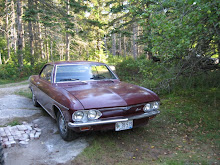
I drove the Corvair around a bit yesterday and instantly reminded myself of the dictum laid down by the great Colin Chapman of Lotus automobile fame: "Add lightness." Denise McCluggage, the astonishing race car driver/columnist/Land Rover and Corvair enthusiast, captured this in her latest Autoweek column, "Impress Me With Lightness."

The Lotus 7 epitomized the Chapman ethos; the first ones had barely a 1-liter engine propelling an insanely light car at amazing speeds. Since it weighed so little, the brakes could be light because they required little work to slow down the car. To this day, Lotus cars focus on light, lithe handling and styling. They economize on weight, not on engineering.
Around the same time Chevrolet engineers first looked to cut weight on their new rear engine/ rear transmission/read wheel drive car. They knew instantly they had a nimble car in their hands. For its wheelbase [a mere 1" shy of a 109" Land Rover] they had a 5-6 seat car small for its era, and one with a rear weight bias that would enable it to turn with the lightest touch of a steering wheel.
45 years after the manufacture of my 1996 Corvair, that feeling still imbues itself in the car. The slim windshield pillars, the lack of a "B" pillar, and the large rear window assures that the car's greenhouse lets in a lot of sun and light. You feel more nimble inside and whenever you touch a control, there's none of that push and shove you expect in an American performance car. Everything is light and smooth - just the way it should be in a driver's car.

The Corvair never offered power assist for steering or for braking - neither were necessary because of its engineering. Although the steering ratio is statistically slow, the gentle oversteer inherent in a rear engined car means that a light turn of the wheel, combined with a firm foot on the the throttle, will move the car smartly in the desired direction. You can feel it pivot, just like you can skiing or snowboarding. It's a fabulous feeling, largely unknown in contemporary cars. It makes the simplest drive around the island an absolute delight.

The Lotus 7 epitomized the Chapman ethos; the first ones had barely a 1-liter engine propelling an insanely light car at amazing speeds. Since it weighed so little, the brakes could be light because they required little work to slow down the car. To this day, Lotus cars focus on light, lithe handling and styling. They economize on weight, not on engineering.
Around the same time Chevrolet engineers first looked to cut weight on their new rear engine/ rear transmission/read wheel drive car. They knew instantly they had a nimble car in their hands. For its wheelbase [a mere 1" shy of a 109" Land Rover] they had a 5-6 seat car small for its era, and one with a rear weight bias that would enable it to turn with the lightest touch of a steering wheel.
45 years after the manufacture of my 1996 Corvair, that feeling still imbues itself in the car. The slim windshield pillars, the lack of a "B" pillar, and the large rear window assures that the car's greenhouse lets in a lot of sun and light. You feel more nimble inside and whenever you touch a control, there's none of that push and shove you expect in an American performance car. Everything is light and smooth - just the way it should be in a driver's car.

The Corvair never offered power assist for steering or for braking - neither were necessary because of its engineering. Although the steering ratio is statistically slow, the gentle oversteer inherent in a rear engined car means that a light turn of the wheel, combined with a firm foot on the the throttle, will move the car smartly in the desired direction. You can feel it pivot, just like you can skiing or snowboarding. It's a fabulous feeling, largely unknown in contemporary cars. It makes the simplest drive around the island an absolute delight.
Saturday, January 15, 2011
Who Needs Reverse?
Last fall the Corvair played a major role in getting me back and forth from Bristol, ME, to Rockland [about 100 miles round trip] where I catch the ferry home to Vinalhaven. The bi-weekly drives demonstrated the Corvair's nimble, light driving traits but also two potential problems: one involved a noise emanating out of the right rear of the car; the other was a marked, albeit occasional reluctance to engage reverse gear.

In December, the Corvair returned to the island, its chores completed. The local mechanic put the car on his lift for me and together we examined the rear wheel's brake shoes and springs. They looked perfect. Then we unbolted the rear half shaft from the right side - sure enough, the noise continued as the hub rotated. Steve Goodman of Rear Engine Specialists in Golden, CO, had a rebuilt rear hub assembly ready to go and shipped it out to me. When the mechanic had some weekend time, we installed it in the car and the wheels now rotated smoothly.
Then issue #2 reared its head. The Corvair was parked facing the harbor alongside my shop. One day I filled it with recyclables to take to our local dump and the car would not go into reverse gear. Nothing I did would coax it into gear. I bared my problems to a Corvair forum and discovered I likely had a worn out coupling in the shifter linkage.
So a few days later I bummed a trolley jack from a friend and with a second mate, crawled under the car to examine the linkage. Sure enough, we found that a slight tun with a pair of pliers would permit the car the go into reverse. Of course, I could not travel with jacks, jack stands, and a mate to move the car into reverse every time that was necessary, so I looked into purchasing the parts from Clark's in Shelburne Falls, MA.
Clark's Corvair is to Corvair enthusiasts what Cabelo's is to hunters - an emporium of everything you could need for a Corvair. Yes, Clarks had all the parts in stock. But since the job has to be done on a lift, and the local mechanic has marginal enthusiasm for digging into old cars, I hesitated to purchase the additional parts.
Then a machinist friend suggested the wayward linkage pieces could be tack welded for the short term. It took the local mechanic 20 minutes to complete the job, and sure enough, it worked quite well. Reverse is now engaged easily, and if the weld holds for a while, I can wait on the new parts until the mechanic is in a good mood to tackle the inevitable replacement.
Did I mention that I had loaded up the car with a dump run of stuff before I tried to engage reverse? No? So the mechanic looks inside the car and sees a couple of Christmas wreaths. "What are those for" he asked, "are you finally going to bury this thing?"
The dump is open tomorrow so I can finally empty out the interior of the car - and I parked the car facing forward just in case.

In December, the Corvair returned to the island, its chores completed. The local mechanic put the car on his lift for me and together we examined the rear wheel's brake shoes and springs. They looked perfect. Then we unbolted the rear half shaft from the right side - sure enough, the noise continued as the hub rotated. Steve Goodman of Rear Engine Specialists in Golden, CO, had a rebuilt rear hub assembly ready to go and shipped it out to me. When the mechanic had some weekend time, we installed it in the car and the wheels now rotated smoothly.
Then issue #2 reared its head. The Corvair was parked facing the harbor alongside my shop. One day I filled it with recyclables to take to our local dump and the car would not go into reverse gear. Nothing I did would coax it into gear. I bared my problems to a Corvair forum and discovered I likely had a worn out coupling in the shifter linkage.
So a few days later I bummed a trolley jack from a friend and with a second mate, crawled under the car to examine the linkage. Sure enough, we found that a slight tun with a pair of pliers would permit the car the go into reverse. Of course, I could not travel with jacks, jack stands, and a mate to move the car into reverse every time that was necessary, so I looked into purchasing the parts from Clark's in Shelburne Falls, MA.
Clark's Corvair is to Corvair enthusiasts what Cabelo's is to hunters - an emporium of everything you could need for a Corvair. Yes, Clarks had all the parts in stock. But since the job has to be done on a lift, and the local mechanic has marginal enthusiasm for digging into old cars, I hesitated to purchase the additional parts.
Then a machinist friend suggested the wayward linkage pieces could be tack welded for the short term. It took the local mechanic 20 minutes to complete the job, and sure enough, it worked quite well. Reverse is now engaged easily, and if the weld holds for a while, I can wait on the new parts until the mechanic is in a good mood to tackle the inevitable replacement.
Did I mention that I had loaded up the car with a dump run of stuff before I tried to engage reverse? No? So the mechanic looks inside the car and sees a couple of Christmas wreaths. "What are those for" he asked, "are you finally going to bury this thing?"
The dump is open tomorrow so I can finally empty out the interior of the car - and I parked the car facing forward just in case.
Friday, January 14, 2011
A Man After My Own Heart

Here's a man after my own heart - a classic car enthusiast who's decided to drive his Model A Ford as his daily driver for a year.
His most recent trip is chronicled here.
I've owned one new car in my life, a 1972 Siimca. Once in the '70's, with a '74 VW Beetle Convertible, and twice in the 1980's, with two Jeep CJ's, I've bought cars manufactured in the same decade as my purchase of them. Otherwise, I've always run very used classic cars as daily drivers.
That has not been without incident, but as Jonathan Klinger maintains in the column above, there's a connection to your landscape, a self-reliance, and a connection to machinery that comes from relying on a classic car rather than just waxing it or writing checks to restorers and mechanics.
Bravo, Jonathan, and keep up your quest!
Thursday, January 13, 2011
A Winter Drive
Vinalhaven caught a good sized snowstorm the other day, and finally, after a day and a half of snow, high winds and no ferry service, the sun broke through and the fun of winter driving returned to the island.
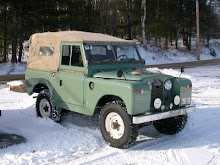
The '66 Land Rover has a yellow topped handle on the right side of the transmission tunnel. You give it a pound with your hand and the car goes into high range 4 wheel drive. At that point it can climb over most snow drifts and plunge down lanes that have not seen a plow this winter.
If the snow is really deep, or you need to slow down while still having lots of torque, pull back the red topped lever and you'll select low range 4 wheel drive. At this point the car can trundle across the snow so slowly it does not even register on the speedometer. In 4th gear the car will barely do 25 mph in low range.
The Land Rover makes the job of checking on otherwise-closed summer properties on the island a real treat. It's been a fun afternoon's "work."
The '66 Land Rover has a yellow topped handle on the right side of the transmission tunnel. You give it a pound with your hand and the car goes into high range 4 wheel drive. At that point it can climb over most snow drifts and plunge down lanes that have not seen a plow this winter.
If the snow is really deep, or you need to slow down while still having lots of torque, pull back the red topped lever and you'll select low range 4 wheel drive. At this point the car can trundle across the snow so slowly it does not even register on the speedometer. In 4th gear the car will barely do 25 mph in low range.
The Land Rover makes the job of checking on otherwise-closed summer properties on the island a real treat. It's been a fun afternoon's "work."
Wednesday, January 12, 2011
Chrysler = Lancia?
Autoweek reports that Fiat is going to take the "new" Chrysler 200 and call it a Lancia in Europe.
The Lancia version will come in both the clunky sedan and the antiquated, unsporting convertible. A Chrysler 300 and even a minivan version might appear next year.
Considering that Lancia is generally acknowledged to have built the first GT, and that its vehicles exported here in the 60's and '70's were superbly engineered sports cars and GT's, this move strikes me as pathetic.
I know that Fiat saved Lancia. I know that Fiat saved Chrysler. The Chrysler name in Europe must be mud after their fiascoes with Rootes and Simca. Surely importing mediocre sedans - the 300 needs to shed weight - is not the answer for Fiat.
And we want real Fiats and real Lancias and real Alfa Romeo's back here.
The Lancia version will come in both the clunky sedan and the antiquated, unsporting convertible. A Chrysler 300 and even a minivan version might appear next year.
Considering that Lancia is generally acknowledged to have built the first GT, and that its vehicles exported here in the 60's and '70's were superbly engineered sports cars and GT's, this move strikes me as pathetic.
I know that Fiat saved Lancia. I know that Fiat saved Chrysler. The Chrysler name in Europe must be mud after their fiascoes with Rootes and Simca. Surely importing mediocre sedans - the 300 needs to shed weight - is not the answer for Fiat.
And we want real Fiats and real Lancias and real Alfa Romeo's back here.
Sunday, January 17, 2010
State Inspections


Maine requires that all vehicles except those registered as antiques must undergo an annual safety inspection. Cars over 25 years old can garner antique status; the insurance company I use does not impose mileage restrictions on antique cars.
So why not register all of my cars, which range in age from 30 - 44. as antiques? Maine has a Catch 22 - you cannot have all of your cars registered as antiques. At least one must be registered conventionally.
Annual inspections evoke love/hate feelings. It often feels like it's "stupid stuff" that fails a car: a failed side light, a tiny crack in the windshield, a bit of rust on a rocker panel, a noisy muffler. I mean, who cares? And the older your car, the more likely that one of these items, that don't really affect whether the car starts or stops, will cause a "failed inspection" notice. Besides, lots of states in the US, like Florida, don't even require inspections.
Last year, the Maine Legislature debated a bill that would have made inspection an every two year event, not yearly, and would have exempted cars under 2 years old. The bill failed after lots of debate. Given new car warranties and extended tire life of radial tires, the 2 year provision made a lot of sense.
Since too many people treat cars like appliances, I have to reluctantly approve of inspections - even though they throw me into a frenzy of fear every year. Todd, our local mechanic, puts every car on a lift and does the right thing. He yanks suspension components, watches for loose tie rod end as you turn the steering wheel, checks for brake pad and brake shoe condition [he will pull off a tire and brake drum if he has not done brake work on your car], tire wear, rocker panel and underbody rust [which are structural on unibody cars], and brake line and gas tank leaks.
He finds that our poor roads, salt water, salt in the air and on the roads, benign neglect of cars and trucks, and manufacturing practices by automakers means that a lot of cars start failing inspections. Since most drivers judge the condition of their car by the condition of the interior, quick starting and a working sound system, they can be incensed when they discover they have to replace a lot of brake lines.
Not me - I am delighted when he find something unsafe on my cars. Even though I crawl underneath my cars all too often, I still don't catch everything as he can when the car is on a lift. So when the Land Rover went in last week for its inspection, he found loose bolts on the spring hangar plate he had replaced this summer and loose nuts on the propshaft where it attaches to the transmission brake. No wonder I had some odd noises on take off! He also spotted a tiny gas tank leak on an area I patched up last summer. I also have a ripped up wiper blade that needs replacement.
The TR-7 had its inspection the next day and it passed without incident. Again, having him underneath the car checking components and looking for rust really helped reassure me about the safe running of the car.
The Corvair and the other Land Rover, the QM I. are both registered as antiques so they avoid inspection, but that doesn't mean I can't pay to have him look underneath the cars for me so I know the work that's required to keep them on the road.
The British have an inspection requirement for all cars, regardless of age, called an MOT. British cars also undergo required emissions testing and in addition to all that we do in Maine, they require that cars don't leak any fluids of any sort! That would fail both the QE I and the QE IV, so I'm glad those British cars are in the US, and not in Jolly Olde.
Friday, December 25, 2009
29 Year Old Road Trip
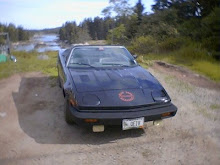
At 29 I loved taking road trips. I've aged, but one car, my 1980 Triumph TR-7, is 29 and still eager to take a ride.
I hadn't the driven the TR much over the early winter, but when an invitation came to visit friends in Connecticut, I decided to make the drive south. The total time each way would be 90 minutes aboard the ferry and 6 1/2 hours on the highways to Fairfield County, CT. The weather forecasts called for sharply decreasing temperatures but unlikely precipitation.
The '66 Land Rover will always make the trip and get you home, but the QE I still has its canvas top [still waiting for a rear door before installing the hard top]. That makes it cold, in addition to noisy and 18 mpg. The TR-7 still gets 26-30 mpg even with 109,000 miles on the odometer, and unlike other TR's, has a real heater and ventilation system. Even with its convertible top, it's fairly tight and warm. I didn't have snow tires, but without a prediction of snow, all should be fine.
So I started up the Triumph and found that, after sitting for a few weeks, it would not idle. It also stalled out a lot. I limped to the local gas station, threw in some dry gas and fresh fuel, and ran the car around the island on a few errands. My trip was to start the next day, so I really hoped this was a temporary condition. I threw the toolkit in from the Corvair and got aboard the ferry the next day.
What could go wrong?
I decided to wash the car when I got to the mainland. After all, every enthusiast knows that a car runs better when it's clean. That night, the temperature dropped precipitously and a fierce wind picked up. So when I parked the car at a motel in Portland, the cold breezes froze up the door locks.
The next morning, I could not unlock the car. I bummed a book of matches from the desk clerk, wrapped a bunch of napkins into a wick and lit the whole thing like a Molotov cocktail. I held it under the key until it singed my fingers. No luck. I ran upstairs to the motel room, aimed the hair dryer at the key until the circuit breaker shut down, and then ran back downstairs with the flaming hot key. Finally, it melted the ice and let me unlock the doors.
On the 4 1/2 trip south, the car ran so well that even the FM radio suddenly started working again! That euphoria lasted until central MA when all radio signals seemed to fade away. I would not pick up a signal again until I crossed into Connecticut.
The last 50 miles of the trip was on the Merritt Parkway, one of the precursors to the interstate highway system. There it appears that the speed limit signs are only decorative; their numbers bear no resemblance to actual traveling speeds. Driving the stated speed limit is an open invitation to be run over.
The TR-7 does not have a GPS so I had to use directions written out on paper in order to find my friend's house. How quaint!
The trip back was a full 6 1/2 hours of relative comfort, stuffed into a TR-7. No wonder that Car and Driver magazine called it "the only sports car we would take on a long trip." For a British sports car without the name "Jaguar" on it, the wedge was remarkably comfortable.
Oh, yes, the car actually ran without incident for the full 600 miles and 13 hours of road time. Triumph used to say the TR-7 was "out to steal the American road." It certainly stole my heart again!
I hadn't the driven the TR much over the early winter, but when an invitation came to visit friends in Connecticut, I decided to make the drive south. The total time each way would be 90 minutes aboard the ferry and 6 1/2 hours on the highways to Fairfield County, CT. The weather forecasts called for sharply decreasing temperatures but unlikely precipitation.
The '66 Land Rover will always make the trip and get you home, but the QE I still has its canvas top [still waiting for a rear door before installing the hard top]. That makes it cold, in addition to noisy and 18 mpg. The TR-7 still gets 26-30 mpg even with 109,000 miles on the odometer, and unlike other TR's, has a real heater and ventilation system. Even with its convertible top, it's fairly tight and warm. I didn't have snow tires, but without a prediction of snow, all should be fine.
So I started up the Triumph and found that, after sitting for a few weeks, it would not idle. It also stalled out a lot. I limped to the local gas station, threw in some dry gas and fresh fuel, and ran the car around the island on a few errands. My trip was to start the next day, so I really hoped this was a temporary condition. I threw the toolkit in from the Corvair and got aboard the ferry the next day.
What could go wrong?
I decided to wash the car when I got to the mainland. After all, every enthusiast knows that a car runs better when it's clean. That night, the temperature dropped precipitously and a fierce wind picked up. So when I parked the car at a motel in Portland, the cold breezes froze up the door locks.
The next morning, I could not unlock the car. I bummed a book of matches from the desk clerk, wrapped a bunch of napkins into a wick and lit the whole thing like a Molotov cocktail. I held it under the key until it singed my fingers. No luck. I ran upstairs to the motel room, aimed the hair dryer at the key until the circuit breaker shut down, and then ran back downstairs with the flaming hot key. Finally, it melted the ice and let me unlock the doors.
On the 4 1/2 trip south, the car ran so well that even the FM radio suddenly started working again! That euphoria lasted until central MA when all radio signals seemed to fade away. I would not pick up a signal again until I crossed into Connecticut.
The last 50 miles of the trip was on the Merritt Parkway, one of the precursors to the interstate highway system. There it appears that the speed limit signs are only decorative; their numbers bear no resemblance to actual traveling speeds. Driving the stated speed limit is an open invitation to be run over.
The TR-7 does not have a GPS so I had to use directions written out on paper in order to find my friend's house. How quaint!
The trip back was a full 6 1/2 hours of relative comfort, stuffed into a TR-7. No wonder that Car and Driver magazine called it "the only sports car we would take on a long trip." For a British sports car without the name "Jaguar" on it, the wedge was remarkably comfortable.
Oh, yes, the car actually ran without incident for the full 600 miles and 13 hours of road time. Triumph used to say the TR-7 was "out to steal the American road." It certainly stole my heart again!
Saab: An oddball in peril - The Boston Globe
I can't think of a better way to writing my opinions about the demise of Saab than this editorial from the Boston Globe of Christmas Day, 2009:
Saab: An oddball in peril - The Boston Globe
Posted using ShareThis
Saab: An oddball in peril - The Boston Globe
Posted using ShareThis
Monday, October 19, 2009
Birthday Drives
Quechup | Blog: British Invasion
Shared via AddThis
It's my birthday today so, while working, I've decided to enjoy the day by making certain I drive each of my classic cars today.
So I took the TR-7 out on a ride to check in with a summer vacation house owner. Then I took the Land Rover out to the far end of the island to an estate there to effect a repair on a piece of mowing equipment.
This evening, I'll take a ride in the Corvair coupe just to relish a birthday ride [sadly, the local bar is closed on Mondays], and hopefully figure out what the squealing is from the rear.
Short of a wild night of romance, the cars will provide the best entertainment today.
Shared via AddThis
It's my birthday today so, while working, I've decided to enjoy the day by making certain I drive each of my classic cars today.
So I took the TR-7 out on a ride to check in with a summer vacation house owner. Then I took the Land Rover out to the far end of the island to an estate there to effect a repair on a piece of mowing equipment.
This evening, I'll take a ride in the Corvair coupe just to relish a birthday ride [sadly, the local bar is closed on Mondays], and hopefully figure out what the squealing is from the rear.
Short of a wild night of romance, the cars will provide the best entertainment today.
Subscribe to:
Comments (Atom)




 Posts
Posts

