
In a sad note for genuine auto enthusiasts, Alfa Romeo's planned return to the USA market has been delayed by parent corporation Fiat. Now it looks like the earliest we'll see an Alfa through dealerships in 2013.
According to Autoweek, the delays arise out of Fiat's concerns about the proposed designs and engineering from Alfa's Turin studios, and from the desire to take advantage of economies of scale by melding Alfa and Chrysler's manufacturing capacities. It does appear that some Chrysller products will be badged as Alfa's and/or Lancia's, or the converse might happen, as Alfa's might be badged as Chrysler products.
Whatever the decisions to be reached, the beloved Alfa Spider is out of production with its replacement not scheduled until 2013 also. Let's hope that the decision s reached don't dilute Alfa's automotive DNA!
Monday, April 11, 2011


Sunday, April 10, 2011
"I am a Rock, on an Island"
Land Rovers have always prided themselves as "working vehicles." Indeed the earliest ads for Land Rovers cited their role as the "versatile" car, able to work on the farm and then bring you into town.
This past week I tested the Land Rover's working capabilities against an enormous tree stump and a boulder too heavy for three people to lift out of the ground. My Land Rover ended the week 1-1.

The tree stump presented quite a hurdle. Our crew of three dug around the huge root ball and I took a chain saw to any visible roots. We tied a tow strap and a kinetic rope around the tree stump, and I goosed it up the gravel drive for some 30' before I felt the Rover surge ahead and then get thrust backwards - the kinetic rope acts just like a rubber band. The tree stump never budged. We tried a few more times and then I gave up and called in a backhoe.
The boulder lay under the surface right in line with the trench I had to absolutely, positively dig. Three of us tried to lift it out of the ground but it proved too heavy. We dug around the boulder enough to get a tow strap around the rock, and then attached it to the Rover.

First gear, low range, and then I gave it a slow but steady pace. The rock bounded out of its hole and I dragged it up to a place from which we could roll it off to one side. It took three of us to roll it into the woods. Ashley was particularly proud of conquering the rock.

Needless to say I was very happy to have the Land Rover!
This past week I tested the Land Rover's working capabilities against an enormous tree stump and a boulder too heavy for three people to lift out of the ground. My Land Rover ended the week 1-1.

The tree stump presented quite a hurdle. Our crew of three dug around the huge root ball and I took a chain saw to any visible roots. We tied a tow strap and a kinetic rope around the tree stump, and I goosed it up the gravel drive for some 30' before I felt the Rover surge ahead and then get thrust backwards - the kinetic rope acts just like a rubber band. The tree stump never budged. We tried a few more times and then I gave up and called in a backhoe.
The boulder lay under the surface right in line with the trench I had to absolutely, positively dig. Three of us tried to lift it out of the ground but it proved too heavy. We dug around the boulder enough to get a tow strap around the rock, and then attached it to the Rover.

First gear, low range, and then I gave it a slow but steady pace. The rock bounded out of its hole and I dragged it up to a place from which we could roll it off to one side. It took three of us to roll it into the woods. Ashley was particularly proud of conquering the rock.

Needless to say I was very happy to have the Land Rover!
Saturday, April 2, 2011
Hope for the Future
The Bristol epitomizes all that is right - and wrong - with the British automobile industry.
Built first as a gentleman's sporting car after World War II, their cars have featured quirky styling, so you either love them or hate them. Rarely were two models available at the same time.

They featured robust engines, usually produced by another manufacturer.They also benefited from solid engineering, good brake systems, and handsome, leather and wood interiors. Auto publications have raved about them for decades.

Sadly they also came with high prices. They've been hand built in small quantities to expensive standards under the long time leadership of Tony Crook. You can buy one at only one dealership located in London. The latest models are actually complete rebuilds of older vehicles updated to modern standards.
Now they're "in administration," which is British for bankruptcy. The company is looking for an investor to purchase it and revive the marque. The same process has occurred several times for TVR and that Blackpool manufacturer is still in business.
You have to wish this heritage product well. If you're interested in purchasing the company, here's the link for more information.
Built first as a gentleman's sporting car after World War II, their cars have featured quirky styling, so you either love them or hate them. Rarely were two models available at the same time.
They featured robust engines, usually produced by another manufacturer.They also benefited from solid engineering, good brake systems, and handsome, leather and wood interiors. Auto publications have raved about them for decades.
Sadly they also came with high prices. They've been hand built in small quantities to expensive standards under the long time leadership of Tony Crook. You can buy one at only one dealership located in London. The latest models are actually complete rebuilds of older vehicles updated to modern standards.
Now they're "in administration," which is British for bankruptcy. The company is looking for an investor to purchase it and revive the marque. The same process has occurred several times for TVR and that Blackpool manufacturer is still in business.
You have to wish this heritage product well. If you're interested in purchasing the company, here's the link for more information.
Wednesday, March 30, 2011
Ode to Dave Dudley
"Six days on the road" sang Dave Dudley, back when trucking songs were entertaining. I just spent 700 miles or so traveling in the QE I, my '66 Land Rover Series II-A. I'm still exhausted!
The trip from Vinalhaven started with a 90 minute ferry ride, then a 2 hour drive to Portland, ME. I had invited a group of Land Rover enthusiasts, young and old, male and female, to gather at a brewpub and entertain me. They did a terrific job and I had a ball. I also have new offers of places to stay in the future - very cool.
Then came the next morning's drive to Cos Cob, CT, where I had plans to mooch off of new friends, who own a summer house in the island. I mow their lawns and do some simple chores for them, and in return, they grace me with their friendship, hospitality and friendship. It's a very one-sided deal for me.
Before the long trip, however, I chose to tank up at The Seed and Bean, a coffee house started by Land Rover enthusiast Jassy Smith. Her BFF, Barry Jones, and his dog, Sarge, came along to entertain me even more. The artsy building, Jassy's grandmother's one-time residence, made for a welcome change from the chain coffee houses everywhere else in the country.
 From there it was a noisy 4.5 hour drive to Cos Cob, CT, a village area within Greenwich. The QE I's overdrive linkage had failed two days before departure, but Rovers Down South, which now owns the rights to the Fairey Overdrive, came through with the promise of a linkage rod to be delivered to CT.
Running a Land Rover at highway speeds without an overdrive is not a mechanical problem for the car, but it is a problem for the driver. The gear noise and overall vibration noise is quite high at 60 mph, even with my handheld radio and ear buds. Running a Land Rover at 60 mph is also a financial problem for the driver because of $4.05/gallon gas prices in CT. The Rover gets 18-19 mpg at highway speeds, so it costs a lot to make the 350 mile trip.
While in CT, I met up with Jon, a new enthusiast with a Range Rover Sport, and since I last talked with him in December, two 1980's Land Rovers about to be imported to his driveway in Fairfield. I drove the Rover around Cos Cob and Greenwich a bit, but it mostly sat while I mooched rides or took the train into NYC to gawk and people and buildings. I also saw many Range Rovers and even a Defender in NYC; I could not even imagine driving in Manhattan.
The drive home took 6.5 hours, benefiting from the new overdrive linkage that I installed in an hour the previous Saturday. I felt very tired when I arrived in Rockland, too late to catch the ferry home and worn out by the relative boredom of an interstate drive. The working overdrive did help reduce the fuel usage, though, and made the driving safer. However, the low beam headlights have ceased to work, and I fear that means the dimmer switch must be replaced.
The good news is that the shift lever, worked very calmly by me, remained intact! The bad news is that the latest replacement unit from Rovers North now comes without the mounting bracket, meaning it's not a field repair any longer.
The trip from Vinalhaven started with a 90 minute ferry ride, then a 2 hour drive to Portland, ME. I had invited a group of Land Rover enthusiasts, young and old, male and female, to gather at a brewpub and entertain me. They did a terrific job and I had a ball. I also have new offers of places to stay in the future - very cool.
Then came the next morning's drive to Cos Cob, CT, where I had plans to mooch off of new friends, who own a summer house in the island. I mow their lawns and do some simple chores for them, and in return, they grace me with their friendship, hospitality and friendship. It's a very one-sided deal for me.
Before the long trip, however, I chose to tank up at The Seed and Bean, a coffee house started by Land Rover enthusiast Jassy Smith. Her BFF, Barry Jones, and his dog, Sarge, came along to entertain me even more. The artsy building, Jassy's grandmother's one-time residence, made for a welcome change from the chain coffee houses everywhere else in the country.

Running a Land Rover at highway speeds without an overdrive is not a mechanical problem for the car, but it is a problem for the driver. The gear noise and overall vibration noise is quite high at 60 mph, even with my handheld radio and ear buds. Running a Land Rover at 60 mph is also a financial problem for the driver because of $4.05/gallon gas prices in CT. The Rover gets 18-19 mpg at highway speeds, so it costs a lot to make the 350 mile trip.
While in CT, I met up with Jon, a new enthusiast with a Range Rover Sport, and since I last talked with him in December, two 1980's Land Rovers about to be imported to his driveway in Fairfield. I drove the Rover around Cos Cob and Greenwich a bit, but it mostly sat while I mooched rides or took the train into NYC to gawk and people and buildings. I also saw many Range Rovers and even a Defender in NYC; I could not even imagine driving in Manhattan.
The drive home took 6.5 hours, benefiting from the new overdrive linkage that I installed in an hour the previous Saturday. I felt very tired when I arrived in Rockland, too late to catch the ferry home and worn out by the relative boredom of an interstate drive. The working overdrive did help reduce the fuel usage, though, and made the driving safer. However, the low beam headlights have ceased to work, and I fear that means the dimmer switch must be replaced.
The good news is that the shift lever, worked very calmly by me, remained intact! The bad news is that the latest replacement unit from Rovers North now comes without the mounting bracket, meaning it's not a field repair any longer.
Friday, March 18, 2011
Communing with the Queen
I spent a very happy day lying underneath and over the QE I. Bluntly, if you don't enjoy working on a classic Land Rover yourself, you'll need a dedicated mechanic and some extra funds to use and enjoy the car.
Land Rovers don't require maintenance because they're finicky; it's because their maintenance schedules were created at a time when people drove less [6,000/yr was considered average in the UK in the 1960's] and because Rover knew the car would likely see use in remote areas, far from service facilities. Land Rovers were [and are] exported to well over 100 countries, but in really small numbers [<25,000-30,000 per year]
When you flip through a Land Rover shop manual of the time, you realize that the instructions assume that the reader might not be familiar with Land Rovers and might not have specialized tools. That certainly resonates with me today.
To create a vehicle that will last for a long time, Land Rover made most parts adjustable, fully lubricated and robust. The maintenance schedule calls for attention most often in 3,000 mile intervals -except in "severe uses." That's most of the time, as it turns out.
The basics are easy enough - oil and filter changes at 3,000 or 3 months. whichever comes first. The Land Rover 2.25 liter engine requires nearly 8 quarts of oil with every change. That alone helps longevity. The oil filter is a large cartridge type with a big paper filter inside a cannister - messy but effective. The air cleaner is also the old oil-bath type [that requires a quart of its own] that really keeps air contaminants at bay. With its large radiator and high oil sump capacity, the Land Rover engine can run at optimal temperatures with ease; the oil helps cool as well as lubricate the internal moving parts. The compression ratio is low at 7:1 or 8:1, depending on which cylinder head is on the engine, and that, too, keeps the heat down.
As you might expect, the transmission and transfer case, front and rear axle housings, all have fill plugs and drain plugs that make it easy to add and/or change the gear oil within them. The rear axles are "floating axles" that are bathed in gear oil and easy to replace if broken. The same gear oil lubricates the wheel bearings, too.
Land Rover also used an enclosed globe in which to house the front end "ball joints." As long as you check the gear oil within them, you'll not likely have front end failures, either. The overdrive has its own hypoid reservoir, too, as does the steering box. There aren't that many grease points, and they're confined to the front and rear propshafts.
I used the opportunity to tighten up bolts on the exhaust and spring hangers. Then I decided to check the valve clearances as it had been a couple of years since I'd tested them last. A couple were loose and one was a bit tight, but overall, they were in good shape. While I found it a bit tiring to crawl under and lean over the car all day, it felt good when it ran well at day's end.
Oh, yes, after yet another broken shift lever earlier this week, I finally adjusted out the slave cylinder rod to see if I could ease pressure on the lever. A new one should come soon from Rovers North and I'll carry it with me just in case.
So now the Land Rover is ready for a 600 mile round trip next week.
Land Rovers don't require maintenance because they're finicky; it's because their maintenance schedules were created at a time when people drove less [6,000/yr was considered average in the UK in the 1960's] and because Rover knew the car would likely see use in remote areas, far from service facilities. Land Rovers were [and are] exported to well over 100 countries, but in really small numbers [<25,000-30,000 per year]
When you flip through a Land Rover shop manual of the time, you realize that the instructions assume that the reader might not be familiar with Land Rovers and might not have specialized tools. That certainly resonates with me today.
To create a vehicle that will last for a long time, Land Rover made most parts adjustable, fully lubricated and robust. The maintenance schedule calls for attention most often in 3,000 mile intervals -except in "severe uses." That's most of the time, as it turns out.
The basics are easy enough - oil and filter changes at 3,000 or 3 months. whichever comes first. The Land Rover 2.25 liter engine requires nearly 8 quarts of oil with every change. That alone helps longevity. The oil filter is a large cartridge type with a big paper filter inside a cannister - messy but effective. The air cleaner is also the old oil-bath type [that requires a quart of its own] that really keeps air contaminants at bay. With its large radiator and high oil sump capacity, the Land Rover engine can run at optimal temperatures with ease; the oil helps cool as well as lubricate the internal moving parts. The compression ratio is low at 7:1 or 8:1, depending on which cylinder head is on the engine, and that, too, keeps the heat down.
As you might expect, the transmission and transfer case, front and rear axle housings, all have fill plugs and drain plugs that make it easy to add and/or change the gear oil within them. The rear axles are "floating axles" that are bathed in gear oil and easy to replace if broken. The same gear oil lubricates the wheel bearings, too.
Land Rover also used an enclosed globe in which to house the front end "ball joints." As long as you check the gear oil within them, you'll not likely have front end failures, either. The overdrive has its own hypoid reservoir, too, as does the steering box. There aren't that many grease points, and they're confined to the front and rear propshafts.
I used the opportunity to tighten up bolts on the exhaust and spring hangers. Then I decided to check the valve clearances as it had been a couple of years since I'd tested them last. A couple were loose and one was a bit tight, but overall, they were in good shape. While I found it a bit tiring to crawl under and lean over the car all day, it felt good when it ran well at day's end.
Oh, yes, after yet another broken shift lever earlier this week, I finally adjusted out the slave cylinder rod to see if I could ease pressure on the lever. A new one should come soon from Rovers North and I'll carry it with me just in case.
So now the Land Rover is ready for a 600 mile round trip next week.
Wednesday, March 9, 2011
While Waiting for Results
I'm still waiting for the results of my tuneup work to sort themselves out. The Land Rover still seems to want to cut out under deceleration, but idle and acceleration are now quite fine. Of course, the road conditions in our early "frost heave" season stink so it's hard to tell what of the running is because of the car's bouncing all over the place, and what is a result of additional tuneup still required. I've yet to grab a timing light to check on the timing but I should be able to get one out of storage today.
This entire incident started after tuning up the car in mid-February just before the Maine Winter Romp. The car ran perfectly all weekend, which was part of the reason for my puzzlement, as to its more recent issues.

A participant shot this photo of me enjoying another rover, "Sarge," a 2-year old that came along with enthusiasts Barry Jones and Jassy Smith of Kennenbunk.
So I can enjoy land rovers and Land Rovers, here's hoping my Rover continues to sort itself out.
This entire incident started after tuning up the car in mid-February just before the Maine Winter Romp. The car ran perfectly all weekend, which was part of the reason for my puzzlement, as to its more recent issues.

A participant shot this photo of me enjoying another rover, "Sarge," a 2-year old that came along with enthusiasts Barry Jones and Jassy Smith of Kennenbunk.
So I can enjoy land rovers and Land Rovers, here's hoping my Rover continues to sort itself out.
Sunday, March 6, 2011
Tune ups
The mantra on classic cars is that you love to run them as daily drivers because they're so easy to maintain compared to the complexities of the modern car. Not so fast, please.
First comes the QE I, the Land Rover. Although I swapped out points/rotor/condenser before the Maine Winter Romp in February, the car started to run poorly the following week. Suddenly one morning it absolutely would not idle with the choke pushed in all the way. If you let your foot off the accelerator, the car would stall. It would start right up again, but it would not idle.

So I begged the use of the local electric co-op's garage [my cars provide quite a bit of amusement for the linesmen] and got the QE I indoors. I went immediately for the last thing I did, the points, and checked the gap. Yes, they had closed up a bit. This would usually affect starting, too [it didn't for me], but might be part of the problem. I opened them up, put the distributor back together, and started the car. It still would not idle.
So I started with the fuel filter [no water in the gas] and the little filter at the base of the Weber card. Both looked clean. Then I removed the top of the carb and checked the bowl and jets. There was no grit or water in there, but I sopped up the gas and removed and sprayed out the jets. Usually, this is all you have to do with a Weber, but the absence of grit or goop meant I had to go further. I sprayed out every orifice I could find and the removed the side jet.
This jet had a black sooty film on it, so I sprayed out each orifice and wiped the jet clean. I removed the mixture screw/needle and found the same black soot at its tip. I also saw the same stuff on the carb throat. When I cleaned them all up, and buttoned up the carb, I found the car would idle perfectly. Success!
Ah, no. I drove to my job site and found the car would barely accelerate! Worse yet, it was pinging under load. So the next morning I checked the points again and found the points had been gapped too wide. I adjusted them more carefully and then tried the car one more time. It certainly idled fine and there was no more pinging, but the car still bogged on acceleration - pulling out the chock, even when warm, helped, indicating that the carb was still starved.
Yesterday morning, on the advice of the head tech at Rovers North, I enrichened the mixture to see if acceleration might improve. I haven't driven the car far enough to warm up the engine [no choke] to see if there's any improvement but it seems better when playing with the throttle linkage at the carb.
I also tried to bleed the clutch system as the clutch doesn't seem to work as well as it did once, but the bleeder screw seemed corroded in place. So I sprayed it up with penetrating oil to see if I could loosen it in the future.
The good news - all the tools required for this repair included a flat head screwdriver, a feeler gauge, working eyes and ears. It also required you to think through a diagnostic scheme and effect a solution. The total cost was $0.
The bad news - it couldn't be fixed by simply swapping out a part for a very expensive new one at a shop that gave you free coffee, a tv showing bad programming, and an expensive ride to work.
Ah, I'll accept those tradeoffs any day.
On the even-better side, I dug the Corvair out of its snowbank and found it started perfectly, leaked some oil gently, and drove wonderfully on a short ride to work. What a sweet car!
First comes the QE I, the Land Rover. Although I swapped out points/rotor/condenser before the Maine Winter Romp in February, the car started to run poorly the following week. Suddenly one morning it absolutely would not idle with the choke pushed in all the way. If you let your foot off the accelerator, the car would stall. It would start right up again, but it would not idle.

So I begged the use of the local electric co-op's garage [my cars provide quite a bit of amusement for the linesmen] and got the QE I indoors. I went immediately for the last thing I did, the points, and checked the gap. Yes, they had closed up a bit. This would usually affect starting, too [it didn't for me], but might be part of the problem. I opened them up, put the distributor back together, and started the car. It still would not idle.
So I started with the fuel filter [no water in the gas] and the little filter at the base of the Weber card. Both looked clean. Then I removed the top of the carb and checked the bowl and jets. There was no grit or water in there, but I sopped up the gas and removed and sprayed out the jets. Usually, this is all you have to do with a Weber, but the absence of grit or goop meant I had to go further. I sprayed out every orifice I could find and the removed the side jet.
This jet had a black sooty film on it, so I sprayed out each orifice and wiped the jet clean. I removed the mixture screw/needle and found the same black soot at its tip. I also saw the same stuff on the carb throat. When I cleaned them all up, and buttoned up the carb, I found the car would idle perfectly. Success!
Ah, no. I drove to my job site and found the car would barely accelerate! Worse yet, it was pinging under load. So the next morning I checked the points again and found the points had been gapped too wide. I adjusted them more carefully and then tried the car one more time. It certainly idled fine and there was no more pinging, but the car still bogged on acceleration - pulling out the chock, even when warm, helped, indicating that the carb was still starved.
Yesterday morning, on the advice of the head tech at Rovers North, I enrichened the mixture to see if acceleration might improve. I haven't driven the car far enough to warm up the engine [no choke] to see if there's any improvement but it seems better when playing with the throttle linkage at the carb.
I also tried to bleed the clutch system as the clutch doesn't seem to work as well as it did once, but the bleeder screw seemed corroded in place. So I sprayed it up with penetrating oil to see if I could loosen it in the future.
The good news - all the tools required for this repair included a flat head screwdriver, a feeler gauge, working eyes and ears. It also required you to think through a diagnostic scheme and effect a solution. The total cost was $0.
The bad news - it couldn't be fixed by simply swapping out a part for a very expensive new one at a shop that gave you free coffee, a tv showing bad programming, and an expensive ride to work.
Ah, I'll accept those tradeoffs any day.
On the even-better side, I dug the Corvair out of its snowbank and found it started perfectly, leaked some oil gently, and drove wonderfully on a short ride to work. What a sweet car!
Saturday, February 26, 2011
Aliens Control Local Snowplows
Yesterday NOAA predicted that Vinalhaven would receive "heavy rain" and little snow from the predicted storm. The storm arrived but so did 3-5" of heavy snow. The "heavy rains" looked like this at Browns Head yesterday.
 During the early afternoon the snow turned to rain, and then by late afternoon, back the snow. The driving in the thick, slushy snow had the Rover slithering everywhere, even in 4wd.
Last night I heard the snowplows at work down my road and here's the result.
 Clearly aliens have taken over the snowplows; who else would so artfully deposit boulders of snow directly in front of the Corvair? Time to get out the pickax.
Last night I heard the snowplows at work down my road and here's the result.

Thursday, February 24, 2011
Way Too Busy
It's embarrassing but lately I've been way too busy to update my life with classic cars. To their credit, it's the classic cars that have enabled me to be productively busy.
First came the shift lever, yes, that one. The one I wrote about last week? Yes, it gave me over 6 hours of carefree driver before snapping as I went into neutral at the local lumberyard. Fortunately I had the predecessor shift lever in the rear of the Land Rover. So I got a lumberyard worker and a local fisherman to help me shove the Land Rover into a parking place and then spent the next 45 minutes swapping out the shift levers.
Last Friday I brought the QE I onto the ferry and headed towards Waterville, ME, where I stayed while participating in The Maine Winter Romp. This year's event featured about 75 Land Rovers and 120 people, including infants, children and friends. The conditions were either rather easy [greenlaning over snowy trails with lots of ruts and soft spots] or extreme [cross axle risks of breaking CV joints on Range Rovers, rear axle shafts on Series Rovers, deep water crossings, icy hill climbs]. There seemed to be nothing in between.

What caused these conditions? Maine has received tons of snow this winter but less extreme cold than in recent winters. So the trails with water crossings featured water and mud instead of the usual frozen sheets of water. Last year featured Land Rovers dancing across the swamps over iced-over fields. This year featured Land Rovers plowing through deep waters.
It really helped to have air lockers, chains, a lift kit and/or a tow or winch on the opposite shore.
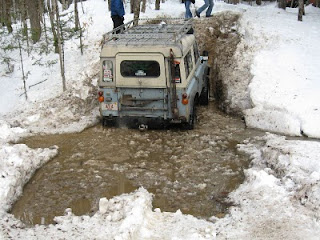
Was it a hugely entertaining time? Yes!


The QE I remained intact the entire weekend and has now been put to more mundane use on the frost-heaved roads of this island taking me back and forth to housepainting work.
First came the shift lever, yes, that one. The one I wrote about last week? Yes, it gave me over 6 hours of carefree driver before snapping as I went into neutral at the local lumberyard. Fortunately I had the predecessor shift lever in the rear of the Land Rover. So I got a lumberyard worker and a local fisherman to help me shove the Land Rover into a parking place and then spent the next 45 minutes swapping out the shift levers.
Last Friday I brought the QE I onto the ferry and headed towards Waterville, ME, where I stayed while participating in The Maine Winter Romp. This year's event featured about 75 Land Rovers and 120 people, including infants, children and friends. The conditions were either rather easy [greenlaning over snowy trails with lots of ruts and soft spots] or extreme [cross axle risks of breaking CV joints on Range Rovers, rear axle shafts on Series Rovers, deep water crossings, icy hill climbs]. There seemed to be nothing in between.

What caused these conditions? Maine has received tons of snow this winter but less extreme cold than in recent winters. So the trails with water crossings featured water and mud instead of the usual frozen sheets of water. Last year featured Land Rovers dancing across the swamps over iced-over fields. This year featured Land Rovers plowing through deep waters.
It really helped to have air lockers, chains, a lift kit and/or a tow or winch on the opposite shore.

Was it a hugely entertaining time? Yes!


The QE I remained intact the entire weekend and has now been put to more mundane use on the frost-heaved roads of this island taking me back and forth to housepainting work.
Thursday, February 17, 2011
It's the Electrics, Stupid
There's nothing more satisfying than believing that your classic car can be "tuned up" by turning a couple of screws on the carburetor[s]. Generally it's totally false while being totally satisfying.
Once again, this canard exposed itself when the Land Rover began to run roughly. My heart cried for a solution that used a flathead screwdriver on the two adjustment screws on the Weber carburetor, but head knew the problem lay inside the distributor.

So I ordered a set of new points, a new condenser and a rotor. I should have ordered a cap, too, but I forgot and lucked out when the current one looked to be in great shape.

I installed them yesterday. The points, condenser and rotor cost less than $10 apiece. Other than the fiddly problem of two tiny screws that you don't want to drop or lose [I used a bit of grease on the end of each screwdriver to "glue" the screw onto the tip of the screwdriver], it's a simple job. I gapped the points to .016, reassembled everything, and started the car - it fired up instantly and smoothly.
I never did touch the carb on the Land Rover. When tuning up the Corvair or the TR-7 with their twin carbs, I find that once adjusted, they rarely go out of adjustment. The Corvair's points distributor really determines how well it starts and runs; the TR-7 has the Lucas "electronic ignition," which means no points but the common rotor and cap only.
No question, fiddling with the carbs provides more entertainment and less back-breaking leaning over the car, but poorer results. Most of the time, it's the electronics, stupid.
Once again, this canard exposed itself when the Land Rover began to run roughly. My heart cried for a solution that used a flathead screwdriver on the two adjustment screws on the Weber carburetor, but head knew the problem lay inside the distributor.
So I ordered a set of new points, a new condenser and a rotor. I should have ordered a cap, too, but I forgot and lucked out when the current one looked to be in great shape.
I installed them yesterday. The points, condenser and rotor cost less than $10 apiece. Other than the fiddly problem of two tiny screws that you don't want to drop or lose [I used a bit of grease on the end of each screwdriver to "glue" the screw onto the tip of the screwdriver], it's a simple job. I gapped the points to .016, reassembled everything, and started the car - it fired up instantly and smoothly.
I never did touch the carb on the Land Rover. When tuning up the Corvair or the TR-7 with their twin carbs, I find that once adjusted, they rarely go out of adjustment. The Corvair's points distributor really determines how well it starts and runs; the TR-7 has the Lucas "electronic ignition," which means no points but the common rotor and cap only.
No question, fiddling with the carbs provides more entertainment and less back-breaking leaning over the car, but poorer results. Most of the time, it's the electronics, stupid.
Subscribe to:
Posts (Atom)




 Posts
Posts

