You can't be a car guy without having a soft spot for Alfa Romeo, the quintessential sporting marque now owned by Fiat.
As a Corvair owner, I have an additional soft spot because Fiat also once embraced rear engine, rear wheel drive cars. They weren't air-cooled but they did provide sparkling handling, performance and interior room from small cars with small engines.
So this latest good news from Alfa, courtesy of AutoWeek, brought a smile to my face on this blizzard of a day. Imagine having both a Fiat 500 and an Alfa sedan available in the US - or dream even bigger for the return of the Fiat and Alfa Spiders!
Oh, and yawn, Alfa will also sell a version of the Jeep Compass badged as an Alfa. Hopefully they'll improve the handling, too.
Today's storm has only buried my cars deeper into the ever-increasing depth of standing snow on the island.
Land Rover enthusiasts admit only modest envy at Jeeps. Yes, we all know that the first Land Rovers used WW II surplus Jeeps as the basis for our first model, and yes, Jeeps always seem to cost less and enjoy less expensive parts support. There are far more Jeeps sold than Land Rovers, too.
Still, it was good news to read that Jeep's current parent, Chrysler, seems to have returned to reasonable financial health. Their current model lineup has freshened up offerings that include the Fiat 500, which entices me greatly, as well as the traditional high horsepower sedans that made the Mopar name a byword for automotive performance. All of this is good news.
The bad news for auto enthusiasts rests in questions as to whether Gen Y, men and women ages 21 - 34, can afford to buy new cars at all. Saddled with high credit card and student loan debt, they find it difficult to secure financing. With the smallest new cars starting at $12,000 or so, the prices rise quickly by the time that dealers have added options desired by [relatively spoiled] potential purchasers. The combination of high debt, credit ratings and higher prices for new cars don't bode well for increased sales.
Of course, they could all buy classic cars at affordable prices and enjoy the excitement and self-satisfaction that comes from quality engineering and the self-reliance that comes from personal maintenance.
Residents of this island town have become a bit weary from the endless series of snowstorms that have hit the island. There's no question that the disruptions experienced by urban centers like Washington, DC and New York City loom much larger in the public mind than the drifting and blowing snow did here today. Still, we're all ready to call winter a success and move on to Spring.
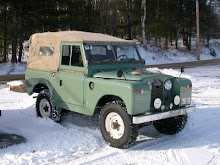
That's not in the cards for us, though, so we continue to shovel and plow, shovel and plow. The Corvair returned to its parking spot last night and now sits quite plowed in by the latest road crew work . The Land Rover had sat for days, squished between the side of the road and my waterfront shop. The Rover tilted to the right in accordance with the land it sits on. If I drove the Rover straight through the snow it would wind up in the harbor due to the slope of the land. If I backed it up too far, it would smash into the Corvair. So it needed to move a very slight distance under a tight left turn through a large snowdrift. This called for low range, 1rst or 2nd gear only.
This required a bit of careful back and forth, but in the end, the Rover drove out without additional shoveling and drove me around the island on today's EMT chores and other work. Our roads remain totally snow covered and the Rover dances around them with pleasure.
An odd incident on the ferry with the Corvair almost left a sour taste about my beloved 1966 Corvair. As we approached Carver's Harbor on Vinalhaven, I started up the car. Happily, it fired up without incident but in my side mirror, I noted an unusual red blinking light behind me. For a moment, I thought it might be the reflection of a blinking buoy light, but then I realized there were none in this part of the harbor.
Then a neighbor knocked on the car's window and said "your flashers are on." Now on late afternoon runs in winter darkness, the ferry captain and crew restrict vehicles from turning on lights until the boat is docked - it reduces problems with night vision. So I took her missive seriously; I also knew that a 1966 Corvair has no "emergency flashers." What it meant was that a short circuit of some sort was sending current through my blinkers to all the rear taillights. I fiddled with the directional lever and lucked out - the blinking stopped (however I note that the problem still continues a couple of days later whenever I turn on the blinkers). Sigh...yet another electrical quirk to trace and repair.
With the Corvair home, I backed it down a slight slope by the harbor beside my shop. Then it snowed yet again and the car sat covered with snow. This afternoon, my EMS chief asked for my help through a ride to get his Jeep at the local repair garage. The chief has a slipped disc, and he feared that trying to climb up into the Land Rover would be too painful for him. I averred that the Corvair sat quite low to the ground, but he insisted he'd prefer that option.
So I went to start the Corvair. Naturally, it foundered when the undercarriage got hung up on a snowdrift. I shoveled underneath the car for a few moments and a carpenter working next door came out to give me a mighty shove. So I got the chief ("Wow, this car is low!") and drove him around on our snow covered roads to complete his errands. He asked about the defroster (which takes a while to work because the engine is slow to warm up) and I pointed to the roll of shop towels in the back seat. The drive brought back memories for him of a VW Beetle with the same defrosting traits, and no doubt a secret wish that he had requested assistance from someone, anyone, with a normal, conventional car.
Then came an EMS call, which I drove to in the Corvair, relishing its traction and nimbleness on the snow covered roads. Two hours later, I needed a ride to get my own car from the patient's house. A charming 20-something drove me in her Prius [spare me!], which she extolled, until she saw the Corvair. Even in the dark, she oohed at its Italianate lines. She'd never heard of a Corvair but pronounced it "hot." I could only hope that the same sentiment would wash onto me as well.
See why I'm happy driving the Corvair in the snow?
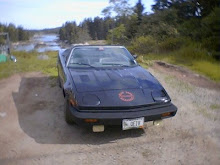
I try not to drive my Monza on the mainland in the winter because of the heavy use of salt compounds on the roads. However, the vagaries of securing a spot on the island ferry forced me to resort to alternative plans.
So when I had to be off island today to give a talk at the library in Tenants Harbor, ME, I found it necessary to bring the car off island late last week and leave it in the parking lot at the mainland ferry terminal. There it sat through last weekend's major snowstorm and temperatures of -10 F last night.
This morning, I brought along a snow shovel and boarded the ferry to get the Corvair. The island temperature was -3 F in the harbor; the "warmer" water created a layer of frozen fog, called "sea smoke," over the water the entire 90 minute trip.
Not surprisingly, the Corvair sat in piles of snow moved around by the snowplows over the weekend. A nice strong wind blew the cold through me as I unlocked the car - I was delighted to find the locks had not frozen in the cold. However, all the windows had iced up, inside and out, from the intense cold.
I turned the key and waited a few moments for the electric fuel pump to push some gas around; the car had not been driven since last Thursday. I pushed in the clutch to relieve some pressure and cranked the engine. It took several tries to get it to even cough, but it would not really fire up.
Out came the starting ether, purchased last week just in case, and a quick shot was sent through the air cleaner snout. I waited a minute or so for it to vaporize and then cranked the starter anew. This time it fired and stalled - and did so a couple of times whenever I released the clutch - but it started successfully and I let it warm up a bit.
Eventually the engine warmed up enough to get heat and defroster action and the car ran just fine over the 25 mile drive back and forth. The two lane road down the St. George Peninsula ran past woods and fields, where you found drifting snow blowing across the road in stiff winds. Nicely, the Monza did not wiggle in any of those gusts.
When I came back late this afternoon on the last ferry, the Engineer working that run gave me a "thumbs up" and tracked me down to tell me of his family's EM convertible. Another crew member asked "when are you going to get it restored?"
You have to love a 45 year old car that can still operate as entertaining, reliable transportation in the dead of winter.
It pains me to write this but there are times when a Land Rover enthusiast must admit defeat. Yesterday night, confront by a pickup truck with its plow buried in snow and right wheels off a path, I had to admit I was no going to rescue this truck.
My buddy Phil has requested me to extricate his vehicles with my "Jeep" on several occasions over the years and I have always responded like a puppy offered table scraps. So when Phil told me at rehearsal that he buried his pickup on a private lane called the A.O. Smith Road, I was thrilled.
So at 5:30 pm last night, we jumped into the QE I and drove the several miles to the northwest side of the island. On the way, Phil told me of his efforts at plowing the road, and those of another caretaker named Charlie, on the same road. Charlie had to abandon his truck and get a larger truck to pull out truck #1; he never did finish his plowing before dark. Phil had to walk out of the lane and another 1/2 mile before arriving at an occupied house, where the owner gave him a ride back to the village.
When we turned onto the A.O. Smith Road [the term 'road' here is wildly optimistic] I could feel the Rover struggling through the soft snow. I could also see that the depth of the snow was substantially higher in this wooded area than the drifting in other parts of the island. I also noted we were heading down the lane without any place to turn off or around. Phil helped construct this road to he's warning me constantly about where the road drops off into ditches.
As we drive along I ask Phil to describe how his truck sits on the lane. That's when I learned that the pickup sat on the right side of the road, its left side wheels spinning in air, and facing us as we progressed up the lane. Now I realize that at best, I'm going to have to try an extrication pulling in reverse - which means only one transmission speed which would likely be too low to get an effective pull.
The last challenge was a series of snowdrifts left by Phil's unsuccessful and incomplete plowing. Whenever his plow pushed too much snow, it stopped his truck cold. I had to ram through five of these artificial drifts before reaching his truck.
But at this point I also realized that my traction, adequate to move the Land Rover forward and backwards, was totally inadequate to gain traction sufficient to pull the front heavy pickup. I could barely move the Rover, let alone the dead weight of a pickup and plow.
So we gave it a try with a tow strap and shackles. The temperature had plummeted to 18 degrees and my hands hurt as I maneuvered the shackles. We tired a couple of pulls before I admitted this truck was going nowhere. I could barely get traction to pull the Rover rearward. What I needed - and lacked - was a winch and a snatch block. Phil's truck needed to be winched out at an angle, using a tree to provide the necessary triangulation.
Now we confronted several hundred yards of rearward driving before a turnaround spot appeared off the road. To do this, I had to open the rear door as Phil, with his flashlight, led me backwards down the lane. With the steering wheels in the rear, the Rover yawed from side to side along the lane, but we finally made the turnaround, and headed for the village.
Maybe tomorrow we can borrow a backhoe, or the electric company's boom truck and winch, to pull the truck back onto the lane. The Rover - sadly - cou
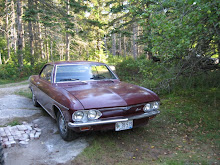
I drove the Corvair onto the ferry the other day, but not without a grimace from a crew member who looked askance at the car. That fact was passed along to me by an off-islander in a pickup behind me. He saw the crew member stare underneath the rear of the car, and it left him with the impression "that I didn't know if they'd let you aboard."
The crew member peered into the window and asked, "is it leaking gas or oil?" I suggested oil as the engine was in the rear, and the gas tank was up front. He made a face and waved me aboard the boat.
Ninety minutes later, when we prepared to disembark, the crew member listened to me start up the car, turned to face me, and held his nose. He attempted to provide levity with a grin, but all I could think of was duplicity. See, we were aboard a 40+ year old ferry with two huge diesel engines of the "black belch" variety and their fumes wafted through the cabin the entire voyage. Who, I might ask, are you calling "smelly." He would later protest that he simply felt the car emitted too many hydrocarbons, unlike apparently, the MV Everett Liibby.
When the Corvair arrived in the parking lot of a local discount auto parts place, it was very well received indeed. When the charming 20-something who cuts my hair saw the car arrive at her shop, her words and body language convinced me of her sincerity about the beauty of the Corvair [of which she knew nothing; her first car, she rhapsodized, was purple 1995 Chevy Cavalier, a car that helped lead GM into eventual bankruptcy.] No wonder she liked the looks, the sound and the smell of the Corvair.
A year ago yesterday, Robert B. Parker died at his desk while writing the then-latest Spenser detective novel.
We lost a truly popular novelist who used the mystery format to present serious ideas to readers. Most of the time we didn't realize that we were engaged in significant thinking; we were too busy helping Spenser and his cohorts - Susan, Hawk, Vinny, Lt. Quirk, Sgt. Beldon - solve his largely Boston-based mysteries. When you finished the chapter, however, you knew that Parker had slyly managed to make you think harder than expected.
Parker had a nifty eye for popular culture and inserted many references into his books. His characters understood the iconic nature of automobiles. Parker always seemed to choose the right car for the right character. He wasn't a car guy per se - most people aren't - but he knew that readers would know more about a character if he identified the character's ride.
His main characters, whether Spenser, Jesse Stone or Sunny Randall [the latter two the central figures in other series of Parker mysteries], changed cars over the decades in response to societal impressions of automobiles. Spenser would move from a tattered-top '70's Chevy convertible to a leaky MGB to a Jeep Cherokee [click here for photos of Spenser's cars].
I miss Parker's fresh wit, crackling dialogue and philosophical insights; I'm still looking for the mystery writer to replace his talents for me.
I drove the Corvair around a bit yesterday and instantly reminded myself of the dictum laid down by the great Colin Chapman of Lotus automobile fame: "Add lightness." Denise McCluggage, the astonishing race car driver/columnist/Land Rover and Corvair enthusiast, captured this in her latest Autoweek column, "Impress Me With Lightness."
The Lotus 7 epitomized the Chapman ethos; the first ones had barely a 1-liter engine propelling an insanely light car at amazing speeds. Since it weighed so little, the brakes could be light because they required little work to slow down the car. To this day, Lotus cars focus on light, lithe handling and styling. They economize on weight, not on engineering.
Around the same time Chevrolet engineers first looked to cut weight on their new rear engine/ rear transmission/read wheel drive car. They knew instantly they had a nimble car in their hands. For its wheelbase [a mere 1" shy of a 109" Land Rover] they had a 5-6 seat car small for its era, and one with a rear weight bias that would enable it to turn with the lightest touch of a steering wheel.
45 years after the manufacture of my 1996 Corvair, that feeling still imbues itself in the car. The slim windshield pillars, the lack of a "B" pillar, and the large rear window assures that the car's greenhouse lets in a lot of sun and light. You feel more nimble inside and whenever you touch a control, there's none of that push and shove you expect in an American performance car. Everything is light and smooth - just the way it should be in a driver's car.
The Corvair never offered power assist for steering or for braking - neither were necessary because of its engineering. Although the steering ratio is statistically slow, the gentle oversteer inherent in a rear engined car means that a light turn of the wheel, combined with a firm foot on the the throttle, will move the car smartly in the desired direction. You can feel it pivot, just like you can skiing or snowboarding. It's a fabulous feeling, largely unknown in contemporary cars. It makes the simplest drive around the island an absolute delight.
Last fall the Corvair played a major role in getting me back and forth from Bristol, ME, to Rockland [about 100 miles round trip] where I catch the ferry home to Vinalhaven. The bi-weekly drives demonstrated the Corvair's nimble, light driving traits but also two potential problems: one involved a noise emanating out of the right rear of the car; the other was a marked, albeit occasional reluctance to engage reverse gear.
In December, the Corvair returned to the island, its chores completed. The local mechanic put the car on his lift for me and together we examined the rear wheel's brake shoes and springs. They looked perfect. Then we unbolted the rear half shaft from the right side - sure enough, the noise continued as the hub rotated. Steve Goodman of Rear Engine Specialists in Golden, CO, had a rebuilt rear hub assembly ready to go and shipped it out to me. When the mechanic had some weekend time, we installed it in the car and the wheels now rotated smoothly.
Then issue #2 reared its head. The Corvair was parked facing the harbor alongside my shop. One day I filled it with recyclables to take to our local dump and the car would not go into reverse gear. Nothing I did would coax it into gear. I bared my problems to a Corvair forum and discovered I likely had a worn out coupling in the shifter linkage.
So a few days later I bummed a trolley jack from a friend and with a second mate, crawled under the car to examine the linkage. Sure enough, we found that a slight tun with a pair of pliers would permit the car the go into reverse. Of course, I could not travel with jacks, jack stands, and a mate to move the car into reverse every time that was necessary, so I looked into purchasing the parts from Clark's in Shelburne Falls, MA.
Clark's Corvair is to Corvair enthusiasts what Cabelo's is to hunters - an emporium of everything you could need for a Corvair. Yes, Clarks had all the parts in stock. But since the job has to be done on a lift, and the local mechanic has marginal enthusiasm for digging into old cars, I hesitated to purchase the additional parts.
Then a machinist friend suggested the wayward linkage pieces could be tack welded for the short term. It took the local mechanic 20 minutes to complete the job, and sure enough, it worked quite well. Reverse is now engaged easily, and if the weld holds for a while, I can wait on the new parts until the mechanic is in a good mood to tackle the inevitable replacement.
Did I mention that I had loaded up the car with a dump run of stuff before I tried to engage reverse? No? So the mechanic looks inside the car and sees a couple of Christmas wreaths. "What are those for" he asked, "are you finally going to bury this thing?"
The dump is open tomorrow so I can finally empty out the interior of the car - and I parked the car facing forward just in case.





 Posts
Posts


